
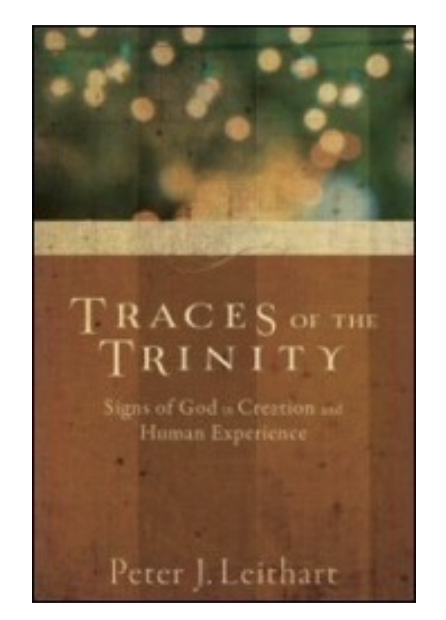
Traces of the Trinity: A First Glimpse

The Trinity leaves fingerprints on every inch of creation. 
The world is crafted to say something true about its Creator.

Celtic Trinity Knot Symbol

I encourage you to read as you listen.  There are footnotes along the way defining unfamiliar words and providing some context for those who want to go a little deeper. (just click the footnote number.)

Traces of the Trinity Podcast – Intro

***

Hey there — welcome to the podcast about Traces of the Trinity, a podcast series that explores a question you might not have asked, but once you do, you might not see the world the same way again:

What if the world itself carries hints — echoes — of the Triune God?

A wise man once said that “Godly speculation can have an edifying function.” That’s a line from John Frame,1Ph.D. Yale University and it’s how Peter Leithart2Ph.D., University of Cambridge kicks off his book Traces of the Trinity.

Peter Leithart – Ph.D. University of Cambridge

So today, we’re going to dip our toes into that idea and see where it might take us.

+++

Picture this: you glance around your room. Maybe you’re driving. Maybe you’re washing dishes. There’s the outside world — stuff, things, people. And then there’s you — thinking, feeling, observing.

Modern people — thanks in part to an anxious Frenchman named René Descartes3René Descartes (1596–1650) was a French philosopher, mathematician, and scientist widely regarded as the father of modern philosophy. Seeking certainty in knowledge, he developed the method of systematic doubt, famously concluding “Cogito, ergo sum” (“I think, therefore I am”) as an indubitable foundation for philosophy. Descartes made major contributions to mathematics, including the creation of analytic geometry, which linked algebra and geometry. In metaphysics, he argued formind–body dualism, distinguishing between thinking substance (res cogitans) and extended substance (res extensa). His most influential works include Discourse on the Method, Meditations on First Philosophy, and Principles of Philosophy. Descartes’ thought profoundly shaped modern philosophy, science, and rationalism. — got used to slicing reality into these neat categories: me vs. world, inside vs. outside, mind vs. matter. Descartes wanted to discover the thing that was indubitably certain, and build from there, so he doubted everything he could see, smell, touch (because those could be illusions, right?) — but he couldn’t doubt that he was doing the doubting.

Cogito, ergo sum. I think, therefore I am. (I really exist!)   And so, following Descartes’ lead, modernity learned to trust the “thinking thing” inside — and eye everything else as suspicious, out there.

But here’s where Leithart says — hold on a second. Is that really how we live?

You are not just an observer floating above the world. You have a body. Try ignoring it for a day. Stub your toe. Bite your tongue. Watch how fast your “inner self” realizes it’s not floating anywhere.

Even more, you need the world to get inside you — literally. You’re breathing air from outside. Drinking water. Eating food that was once something else entirely. If you close yourself off from the world, you don’t become more spiritual — you die.

+++

So here’s where this gets interesting. Leithart takes this ordinary truth — that the world gets into us, and we get into it — and invites us to see it through the lens of the Trinity.

He uses an old theological word you may not have heard: perichoresis — a fancy Greek term that means mutual indwelling. In the Christian tradition, it describes how the Father, Son, and Spirit dwell in each other completely, without losing who they are.

The Father is in the Son, the Son in the Father, and both in the Spirit.4Scripture addresses this theme of mutual indwelling most directly in John’s Gospel, where Jesus articulates the reciprocal relationship between himself and the Father.

Jesus explicitly states that he exists within the Father while the Father simultaneously exists within him (John 14:10–11), a declaration he repeats for emphasis. He grounds this claim in the Father’s active presence—the Father dwelling within him performs the works Jesus accomplishes (John 14:10–11). This mutual indwelling serves as evidence of their unity, inviting belief through the works themselves (John 10:38).

The relationship extends beyond the Father and Son to encompass believers and the Spirit. Jesus promises that his followers will come to understand a threefold union: he dwells in the Father, they dwell in him, and he dwells in them (John 14:20). This pattern of mutual presence becomes a model for Christian experience. In his prayer to the Father, Jesus envisions believers united with both the Father and Son, just as the Father and Son are united with each other (John 17:21).

Regarding the Spirit specifically, Jesus promises the Holy Spirit as a Helper who will dwell with believers and ultimately be within them (John 14:16–17). While the scriptures don’t explicitly state all three persons simultaneously indwelling one another in a single passage, the Johannine material establishes the foundational theology: the Father and Son mutually indwell each other, believers indwell both through faith, and the Spirit indwells believers. Together, these passages construct a picture of trinitarian communion that extends from the Godhead into the church.

It’s a swirl, a dance, a mutual embrace.  Not fusion — not confusion — but an eternal giving and receiving.

And here’s the bold move: what if this pattern is not just tucked away in theology textbooks — but stitched into creation itself? What if the world hums with hints of this divine choreography?

+++

Leithart admits up front — this isn’t a new idea. Theologians from Augustine5Saint Augustine of Hippo (354–430) was a Christian theologian, philosopher, and bishop of Hippo in North Africa, and one of the most influential figures in Western Christianity. After a restless youth, he converted to Christianity in 386 under the influence of St. Ambrose. His writings shaped Christian doctrine on grace, sin, free will, and the Trinity. Augustine’s most famous works include Confessions, a spiritual autobiography; The City of God, a vision of history shaped by the love of God; and On the Trinity. Blending classical philosophy with biblical faith, Augustine profoundly influenced medieval theology, the Protestant Reformers, and Western thought as a whole. to the Cappadocians6The Cappadocians, or Cappadocian Fathers, were three influential 4th-century Christian theologians from Cappadocia (in modern Turkey): Basil the Great, Gregory of Nazianzus, and Gregory of Nyssa. They played a crucial role in defending and clarifying Trinitarian doctrine, especially the distinction between one essence (ousia) and three persons (hypostaseis), helping to establish Nicene orthodoxy against Arianism. Their work shaped Christian theology, worship, and monasticism, and remains foundational in both Eastern Orthodox and Western Christian traditions. before him, loved to talk about the vestigia Trinitatis — the “traces” or footprints of the Trinity. Over the centuries, the tradition fell out of fashion. But Leithart wants to revive it — not to rewrite doctrine, but to stretch our imaginations.

He’s not trying to prove the Trinity from nature — he’s starting with the revealed truth that the Triune God made the world — and saying: shouldn’t we expect the fingerprints to be there? Shouldn’t we expect echoes and clues, spirals and coils, hints and whorls?

+++

So that’s where this little podcast adventure begins. It’s not about nailing down every analogy or diagramming the divine. It’s about training ourselves to look closer, to wonder more deeply. To believe that when you walk outside — when you share a meal — when you hug someone you love — the pattern of giving and receiving, the shape of mutual indwelling, might just be whispering the life of the Trinity.

And maybe you’ve wondered about this too — is the world just cold, hard matter? Or is it, as Leithart suggests, alive with traces of the Triune life that made it?

+++

So if you only remember one thing today, let it be this: You are not a ghost trapped in a machine. You are a body and a soul, part of a world that moves in and through you — and through it, you might just catch the faintest echo of Father, Son, and Spirit at play.

Next time, we’ll move from the preface to the world right in front of us — the desk, the coffee mug, the window, and the old recliner waiting for that afternoon nap.

We’ll keep asking: What if nothing is quite as separate as we thought? What if we’re all caught up in a divine dance?

Until then, take a look around. Listen for the whispers. And maybe — just maybe — you’ll start spotting traces of the Trinity, too.

The Trinity leaves fingerprints on every inch of creation.

+++

1: Traces of the Trinity: Outside In, Inside Out.

I welcome any questions or comments. [Don’t worry, your personal info will not be given to anyone.]