
Traces of the Trinity: I Am His, He Is Mine

Peter Leithart – Ph.D. University of Cambridge
Traces of the Trinity – I am His, He is Mine – Episode 3

***

Hey friends — welcome back to the podcast about Traces of the Trinity.

If you’re just jumping in — here’s your heads up: this episode steps into the realm of love, bodies, sex — and how all that messy, beautiful stuff actually whispers a deeper pattern about reality. So buckle up — this might get awkward. Or it might just be the best thing you hear all week.

Today, we open up Peter Leithart’s Chapter 3 — I Am His, He Is Mine.

***

When we talk about sex in our modern world, it often gets sliced up two ways. Some people crack open an anatomy book — describing all the moving parts. Others — poets, lovers, mystics — reach for a different language. They use metaphor, music, laughter, blushes.

Leithart says — the poets are onto something. Because when a man and woman become “one flesh,” as Genesis says, they do something far more mysterious than biology alone can explain.

***

Think about it: for centuries, lovers have reached for poetry to describe what happens in sex. Shakespeare called it the “beast with two backs.”  Andrew Marvell spoke of rolling all strength and sweetness up into one ball. William Blake asked what men and women truly want — and he answered: “The lineaments of Gratified Desire.”

It’s not just earthy poets. Mystics — Christian, Jewish, Eastern — often turn to the same language when trying to describe what it means to long for God. Song of Songs paints a picture of human lovers — but beneath that heat and longing is a deeper ache: the soul longing for the divine.

***

Karl Barth — the Swiss theologian — said that the difference between male and female is the part of humanity that most deeply reflects God. Because in that difference — and in their union — we glimpse a hint of the Trinity’s life: difference without division, unity without erasure.

The old word for that is perichoresismutual indwelling.

***

And here’s the bold claim: sex is not just physical release. It’s not just pleasure or “exchanging fluids,” as the clinical talk goes. It’s not just biology. It’s a sign — a sign that actually does what it points to.

When a man and woman come together, they quite literally enter one another’s lives — bodies first, but hearts too. He wraps his arms around her; she folds herself into him. They breathe together, kiss together — two becoming one, yet remaining two.

***

Leithart goes deeper. Think about a kiss — just a kiss. Not just a peck on the cheek — but an open-mouth, breath-sharing kiss. It’s intimate, invasive, mutual. Your lips touch. Your breath mingles. You taste each other. You’re sharing life at the gateway of the body.

The mouth is a door — things go in: food, drink, air. Things come out: words, songs, sighs, laughter. The mouth is a threshold where what’s inside becomes outside — and what’s outside becomes inside.

A kiss, then, is a small version of what happens in sex: a mutual opening, a giving and receiving, a little liturgy of indwelling.

***

Now, some might say: “Hold on — that’s just animal stuff. Birds do it, bees do it. Even educated fleas do it.”1Hat tip to song writer Cole Porter But humans are not just animals. We blush. We hide. We veil. We make it private. We wrap sex in poetry, vows, laughter, tears.

Animals don’t write love songs. They don’t close the bedroom door. They don’t feel shame.

That shame points to something bigger: that our sexuality is not just about pleasure — but about communion, about self-gift, about vulnerability that echoes the mystery of our Creator.

***

Leithart reminds us — this union is also the way the world gets peopled. No other human act is so intimately unitive and so profoundly creative. Other pleasures don’t make new life. But this one can — and does.

Through mutual indwelling, two become one — and out of that oneness, a third can come into being. A new person, born from the overflow of mutual gift.

***

But the point isn’t just babies. It’s that the pattern is baked into the act itself — bodies are designed to fit together. It’s not an accident. It’s gift, echo, hint. It’s a physical sign of a deeper reality: that true love wants not just pleasure — but to dwell inside and be dwelled in.

Romantic love wants more than bodies pressed together — it wants stories woven together. It wants a life shared, a world reshaped by a vow.

***

Leithart says: lovers don’t just merge bodies — they merge narratives. He tells how when you fall in love, your life story rewrites itself around the other. Your past, your dreams, your friendships — they all get re-colored. The beach where you honeymooned. The restaurant where you first confessed you were in love. These places get wrapped up in the shared story.

And if you’ve ever lost a spouse, or watched someone grieve — you know it’s true. When one partner dies, it’s like losing a piece of yourself. Because that other person was part of you.

***

Of course, there’s a dark side too. This longing for indwelling can twist into domination. Love can curdle into possession — one person devouring another’s identity. It’s the tragic side of romance: instead of a dance, it becomes control.

True love holds the tension: mutual giving without erasing the other. Lovers “ingest” without “digesting” — they remain themselves, but they dwell in one another, too.

***

So, why does this matter for Leithart’s bigger argument? Because it’s yet another trace. Another clue that the world is stitched together with a triune shape.

Sex is more than sex. It’s a signpost, a sacrament — a bodily icon that points us back to the One whose very life is mutual indwelling, self-gift, other-receiving. Father in Son, Son in Father, both in Spirit.

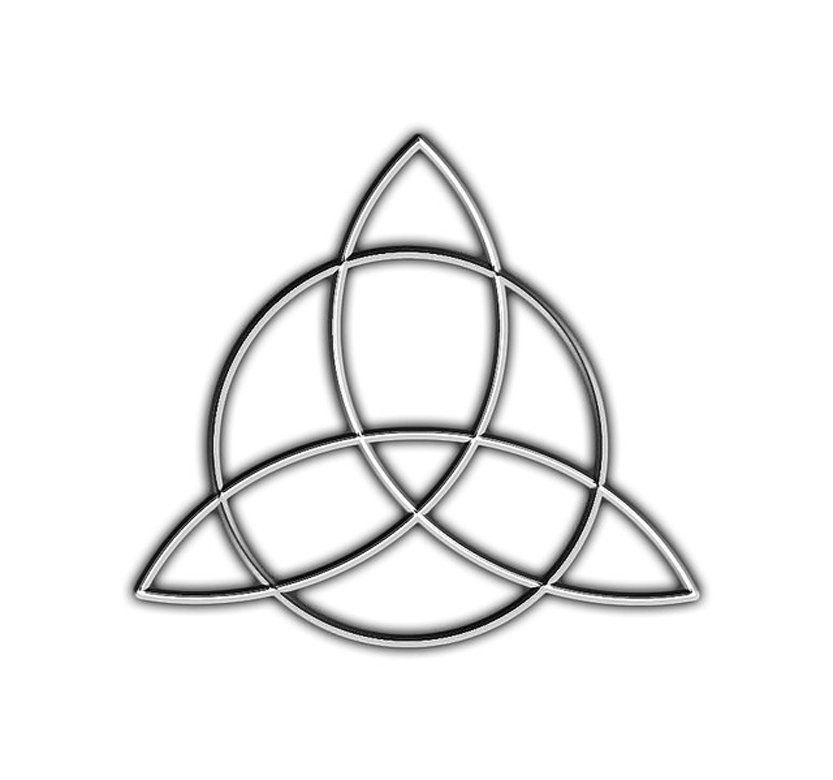
Celtic Trinity Knot

So the next time the world tries to reduce sex to a transaction or just biology — pause. Remember that blush. Remember the veil. Remember the poetry.

Remember that you are built for more — your body testifies that love was always meant to be mutual self-gift. A little earthly echo of a cosmic dance.

***

Next time, we’ll see how this pattern doesn’t stop with lovers. It shapes our sense of time — and even the way we speak and think. But for now, maybe take a moment to remember the gift of bodies, the mystery of desire, the wonder that when we say I am his, he is mine — we’re pointing to something deeper than flesh.

Until next time — keep your eyes open for the traces. They’re everywhere, even in the most private places.

The Trinity leaves fingerprints on every inch of creation.

+++

4: The Presence of the Past – (Episode 4 – coming soon)

I welcome any questions or comments. [Don’t worry, your personal info will not be given to anyone.] Thanks!
Traces of the Trinity: Like Father, Like Son

Peter Leithart – Ph.D. University of Cambridge
Traces of the Trinity – Like Father, Like Son – Episode 2

***

Welcome back to the podcast where we are looking at the book Traces of the Trinity. I’m glad you’re here — because this time, we’re following Peter Leithart into something that hits closer to home than a window or a coffee mug. This episode is all about us — people, families, friendships — and what they reveal aboutthe deep pattern of reality.

The title for Chapter 2 says it perfectly: Like Father, Like Son.

+++

Loneliness — it’s everywhere today. Leithart pulls no punches: modern life, for all its perks, often leaves us alone. We move away from family. We trade roots for freedom. We stand under a big, empty sky — unanchored.

The ancient saints knew solitude — think hermits in deserts, monks in cells — but they didn’t call that loneliness. Loneliness is the ache of disconnection, the hollow echo that something’s missing.

Modern thinkers like Hobbes1Thomas Hobbes (1588–1679) An English philosopher and political theorist, Hobbes is best known for Leviathan, in which he argued that in a state of nature human life would be “solitary, poor, nasty, brutish, and short.” To escape violent chaos, Hobbes maintained that individuals rationally consent to strong sovereign authority through a social contract. His thought laid foundations for modern political philosophy and debates about authority, security, and human nature. and Locke2John Locke (1632–1704). An English philosopher and political thinker, Locke is a central figure of liberal political theory and empiricism. In his Two Treatises of Government, he argued that individuals possess natural rights to life, liberty, and property, and that governments exist to protect these rights with the consent of the governed. Locke also shaped modern epistemology through An Essay Concerning Human Understanding, influencing democratic governance, religious toleration, and Enlightenment thought. told us humans are basically solitary by default — lonely mushrooms that sprout up out of the earth, and only later make contracts and form societies. They imagined we start off alone, and society is tacked on later, like optional furniture, or something.

But Leithart says — look closer. That’s not how we come into the world at all.

+++

How did you get here? Not alone, that’s for sure. You started inside another human being — your mother. Your first home was literally another person’s body. And before you were there, Mom and Dad came together in a moment of intimate indwelling that gave you life.

From the very beginning, we’re social creatures. We’re in others, and they’re in us. You were shaped by your mother’s voice, her moods, her body nourishing yours. And Mom was shaped by you — the kicks, the cravings, the curve of her belly. The dance starts before we take our first breath.

+++

And it doesn’t stop when we’re born. We soak up our family’s habits — how they speak, what they find funny, what they fear. Even our quirks: the “Um” before we answer a question, the laugh, the gestures — all borrowed, passed down like heirlooms. We’re echoes of our parents and siblings, even when we think we’re original.

Leithart uses thinkers like David Hume3David Hume (1711–1776). A Scottish Enlightenment philosopher and historian, Hume was a leading empiricist and skeptic. He argued that human knowledge arises from sensory experience rather than innate ideas, famously critiquing causation, induction, and miracles. His major works include A Treatise of Human Nature and An Enquiry Concerning Human Understanding. Hume’s thought profoundly influenced modern philosophy, especially epistemology and philosophy of religion., Rousseau4Jean-Jacques Rousseau (1712–1778).  A Genevan philosopher and writer of the Enlightenment, Rousseau emphasized the natural goodness of humanity and the corrupting influence of society. His political philosophy, articulated in The Social Contract, introduced the concept of the general will and deeply shaped modern democratic thought. His works on education (Émile) and autobiography (Confessions) also transformed views of selfhood, freedom, and authenticity., and René Girard5René Girard (1923–2015). A French historian, literary critic, and social theorist, Girard developed the influential theory of mimetic desire, arguing that human desire is shaped by imitation and leads to rivalry and violence. He proposed that societies stabilize themselves through scapegoating mechanisms, a process exposed and overturned by the biblical revelation. Girard’s major works include Deceit, Desire, and the Novel and Violence and the Sacred. His interdisciplinary thought has impacted theology, anthropology, literary studies, and social theory. to show how our desires, too, are contagious. We want what others want. We imitate loves and hatreds. We “catch” desires like a yawn or a laugh. We’re constantly mirroring.

So while modern theory loves the image of the lone, self-made individual — the reality is more like a woven fabric. Each life is a thread in a living tapestry. We exist by indwelling one another.

+++

Celtic Trinity Knot

This shapes how we think about groups, too. Family, church, even a sports team — these aren’t just random clusters of individuals. They’re living bodies where each part affects the rest. A leader, for example, isn’t just a person over a group — their presence, their character, filters through the whole network, like nerves running through a body.

Leithart calls this a clue: we don’t just stand next to each other — we live in each other. And if we really get that, then society isn’t just a contract we sign. It’s a web of mutual indwelling.

Sound familiar? That word again — perichoresis. Mutual indwelling is the heartbeat of the Trinity — the Father in the Son, the Son in the Father, the Spirit binding all in perfect communion. And if we’re made in that image, no wonder our life together hums with the same pattern.

+++

So here’s where this hits us today: you can’t be you, fully you, without others. And they can’t be who they are without you. Our families shape our voice, our laugh, our loves. Even our hidden wounds often bear someone else’s fingerprints.

So when you see a family resemblance — the father’s grin in the son, the mother’s wit in the daughter — you’re seeing more than biology. You’re seeing a whisper of the deep reality that holds the world together: we were made to indwell and be indwelled. Like Father, like Son — and like the Son, like the Father.

Next time, we’ll push deeper. We’ll see how this pattern plays out when we talk about love, romance, and bodies that mingle and give life. For now — maybe notice the little echoes in your own life. The phrases you repeat, the stories you carry, the traits you inherited without trying.

We’re not islands. We’re networks. And maybe — just maybe — these connections are faint tracings of the Triune dance.

The Trinity leaves fingerprints on every inch of creation.

+++

3: Traces of the Trinity: I Am His, He Is Mine.

I welcome any questions or comments. [Don’t worry, your personal info will not be given to anyone.] Thanks!

Traces of the Trinity: Outside In, Inside Out

Peter Leithart – Ph.D. University of Cambridge

I encourage you to read as you listen.  There are footnotes along the way defining unfamiliar words and providing some context for those who want to go a little deeper. (just click)

Traces of the Trinity – Outside In, Inside Out – Episode 1

***

Welcome back to the podcast, today we are looking at Traces of the Trinity. If you’re just joining us — no worries. This episode stands on its own, but feel free to catch the teaser we did on the preface whenever you’d like.

So — today we’re stepping into Chapter 1 of Peter Leithart’s book, which he calls Outside In, Inside Out. And just like the title hints — this chapter is all about that fuzzy line between you and everything else.

+++

Let’s start simple. Look around. What’s near you? A desk, a mug, a window, a tree outside? Leithart does this too — he talks about his computer, his books, the couch he naps on, his daughter practicing piano in the next room. It’s all stuff. And in the middle of that stuff — is you.

Now, we’re used to thinking there’s a clean border between “me” and “world.” Modern people inherited that mental map from René Descartes1René Descartes (1596–1650) was a French philosopher, mathematician, and scientist widely regarded as the father of modern philosophy. Seeking certainty in knowledge, he developed the method of systematic doubt, famously concluding “Cogito, ergo sum” (“I think, therefore I am”) as an indubitable foundation for philosophy. Descartes made major contributions to mathematics, including the creation of analytic geometry, which linked algebra and geometry. In metaphysics, he argued for mind–body dualism, distinguishing between thinking substance (res cogitans) and extended substance (res extensa). His most influential works include Discourse on the Method, Meditations on First Philosophy, and Principles of Philosophy. Descartes’ thought profoundly shaped modern philosophy, science, and rationalism.— remember him? The philosopher who got so tangled up in doubt that he had to convince himself, he at least existed — because he was thinking about whether he did.

It’s a clever trick: I think, therefore I am. But it set up this hard divide. Me in here, thinking. World out there, stuff. I’m mind — that’s matter. And modern folks still breathe this air. We often picture ourselves as brains driving a flesh robot through a landscape of objects.

+++

But here’s the twist. Leithart says — is that really how it works? Does that match how we live?

Think about it: you’re not just a mind floating above your body. You are your body. And your body is porous. Air goes in and out. Food, drink — we can’t survive without taking the world in. If the world doesn’t get inside you, you’re done for.

And it’s not just food and air. Light bounces off objects and enters your eyes. Smells slip in through your nose. Sounds vibrate your eardrums. Your skin is a two-way door — heat, touch, all of it. The world comes inside you every moment you’re alive.

And you give back, too. You exhale, sweat, speak, sing, cry. You’re constantly mixing with that “outside.”

+++

Leithart’s point is this: the sharp border between “inside” and “outside” is more like a fuzzy, breathing exchange. And when you see it that way — you start to notice: the world shapes you, and you shape it. There’s this continuous flow.  In & Out.

He talks about how things are more than just lumps of matter. A coffee cup is a cup because it holds coffee. A window is a window because it opens a wall to light. The objects in your room are what they are because of their relations. The lamp isn’t just metal and wire — it lights up your desk, your book. The parts co-define each other.

So objects “indwell” each other. They overlap in function and meaning. And you — the thinking, breathing creature — indwell them, too. And they indwell you. It’s a mesh, not a barricade.

+++

This is where the Trinity connection starts to peek through. Remember that word from last time? Perichoresismutual indwelling. The Father in the Son, the Son in the Father, both in the Spirit.2Scripture addresses this theme of mutual indwelling most directly in John’s Gospel, where Jesus articulates the reciprocal relationship between himself and the Father.

Jesus explicitly states that he exists within the Father while the Father simultaneously exists within him (John 14:10–11), a declaration he repeats for emphasis. He grounds this claim in the Father’s active presence—the Father dwelling within him performs the works Jesus accomplishes (John 14:10–11). This mutual indwelling serves as evidence of their unity, inviting belief through the works themselves (John 10:38).

The relationship extends beyond the Father and Son to encompass believers and the Spirit. Jesus promises that his followers will come to understand a threefold union: he dwells in the Father, they dwell in him, and he dwells in them (John 14:20). This pattern of mutual presence becomes a model for Christian experience. In his prayer to the Father, Jesus envisions believers united with both the Father and Son, just as the Father and Son are united with each other (John 17:21).

Regarding the Spirit specifically, Jesus promises the Holy Spirit as a Helper who will dwell with believers and ultimately be within them (John 14:16–17). While the scriptures don’t explicitly state all three persons simultaneously indwelling one another in a single passage, the Johannine material establishes the foundational theology: the Father and Son mutually indwell each other, believers indwell both through faith, and the Spirit indwells believers. Together, these passages construct a picture of trinitarian communion that extends from the Godhead into the church.

Leithart wants us to see: maybe this pattern isn’t just theology — maybe it’s stitched into how reality works. The world is full of co-living, co-shaping, co-indwelling things. Even solid matter — when physicists zoom in — turns out to be mostly empty space, held together by invisible forces.3This insight comes from modern atomic theory, which shows that what we call ‘solid matter’ is mostly empty space bound by fundamental forces. Nothing is fully sealed off.

Even us. We’re not islands. We’re knots in a web — threads passing through, looping back. The world makes us, we make the world.

+++

So next time you sip your coffee, look out the window, or feel the breeze on your arm — pause. Notice how much of the world is in you. And how much of you is in the world. That border is not a wall — it’s a door.

And maybe — just maybe — all these open doors echo the life of the Triune God, the original mutual indwelling that leaves its fingerprints on everything.

Next episode, we’ll keep going. We’ll look at what happens when this pattern shows up not just between things, but between people. The world is inside you — but so are others. And that, Leithart says, changes everything.

Until then — keep your pores open, your senses awake, and your mind alert for the hidden traces that surround you.

The Trinity leaves fingerprints on every inch of creation.

+++

2: Traces of the Trinity: Like Father, Like Son.

I welcome any questions or comments. [Don’t worry, your personal info will not be given to anyone.]