
***
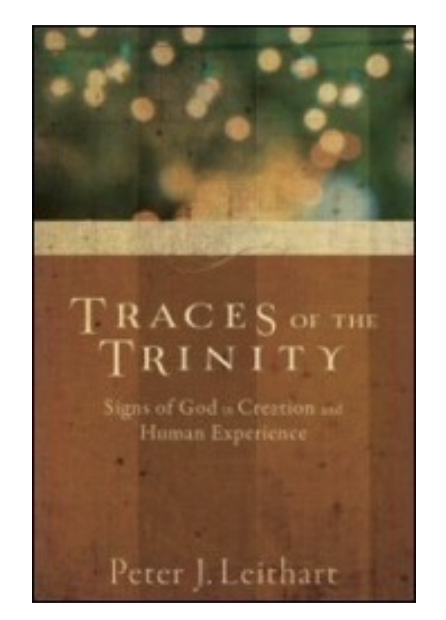
Hey friends — welcome back to the podcast. In this podcast series we are finding out that Traces of the Trinity are everywhere. If you’ve traveled with us so far, you know the drill: we’re following theologian Peter Leithart up this winding mountain path where the world’s everyday features — our bodies, our relationships, our words — all whisper a hidden shape: the triune shape of mutual indwelling.
Today, we step into Chapter 4 — and we’re turning our gaze to something we usually take for granted: time.
Leithart calls this one Presence of the Past.
***
Time is slippery. Augustine1Saint Augustine of Hippo (354–430) was a Christian theologian, philosopher, and bishop of Hippo in North Africa, and one of the most influential figures in Western Christianity. After a restless youth, he converted to Christianity in 386 under the influence of St. Ambrose. His writings shaped Christian doctrine on grace, sin, free will, and the Trinity. Augustine’s most famous works include Confessions, a spiritual autobiography; The City of God, a vision of history shaped by the love of God; and On the Trinity. Blending classical philosophy with biblical faith, Augustine profoundly influenced medieval theology, the Protestant Reformers, and Western thought as a whole. once said, “I know what time is — until someone asks me.” Then it slips through his fingers.
We live inside time. We watch it tick by on screens and clocks. But do we ever really see it?
Leithart says: look again. Because if you pay attention, even time reveals the same strange pattern — inside and outside, past and future, all tangled up inside the present.
***
Here’s the classic problem. The past? It’s gone — right? I am no longer the child obsessed with football, no longer the teen at my first job. That version of me doesn’t exist anymore. The past is memory.
The future? That doesn’t exist either — not yet. It’s all possibility. Plans, hopes, fears — but they’re not real today.
So what do we have? We have now. But here’s Augustine’s puzzle: as soon as you name the present, it vanishes. It’s swallowed by the past. The present is a knife edge — and it’s gone before you can point at it.
So how does this fragile sliver hold our lives together?
***
Leithart says: it does — because the past and future don’t just hover outside the present. They dwell inside it.
Think about it: you remember what you did this morning. (At least I hope you do.) You remember your childhood. Those memories live in you. They shape you. They are you, in part.
And the future? It leaks into now, too. You’re listening to this podcast probably because you hope to learn something, to grow, to reach some future you want. Deadlines push us. Dreams pull us. Futures shape the present.
***
Leithart borrows an idea from Eugen Rosenstock-Huessy2Eugen Rosenstock-Huessy (1888–1973) was a German social philosopher, historian, and Christian thinker known for his emphasis on speech, community, and historical transformation. Trained in law and history, he rejected purely abstract philosophy in favor of a dialogical, lived understanding of reality, arguing that human life is shaped by command, response, and shared language. After emigrating to the United States in the 1930s, he taught at Harvard and later at Dartmouth College. His major works, including Out of Revolution and Speech and Reality, explore how language, faith, and social order arise through historical crises and renewal.— a quirky name, but worth remembering. Rosenstock-Huessy said that time isn’t just clock ticks on a wall. Real time is shaped by what fills it.
A basketball game has its own time — the “time of the game” isn’t just minutes. It’s the drama, the rush, the roar of the crowd.
A classroom has its own time — the old knowledge of the teacher meets the fresh curiosity of students. Past and future collide in the present moment of teaching.
History itself works this way. We speak of “the Victorian Age,” “the Reformation,” “the Digital Era.” These aren’t just dates — they’re times-with-shape, where past, present, and future press into each other.
***
So look around your life. You’re surrounded by traces of the past. The buildings in your town — someone built them decades ago. That chair you’re sitting in? Designed, carved, assembled long before you sat down. Your own body bears scars, moles, wrinkles — little footprints of time.
The future lives here too. Maybe you wear a ring, a sign of promises made long ago that bind you now and propel you ahead. Maybe you’re studying for a test or saving for a trip. The future inhabits your present — just like the past.
***
Leithart says: this is the same Möbius twist we’ve seen all along. Things that are separate actually dwell in one another. Just as your body is not sealed off from the world but porous — so time is not chopped into neat slices. It’s a swirl.

Without memory, there is no now. Without anticipation, there is no present action. The past makes sense only because it lives on in us. The future only matters because it reaches back to tug at our now.
***
And here’s the deep point: time’s dance of mutual indwelling points us to the Triune God.
For Christians, God is not frozen above time, untouched and unmoved. He steps into time — in Christ, in history, in the Spirit who inhabits every moment.
And the Trinity itself is a dance of eternity — Father, Son, and Spirit indwelling, pouring life into each other without beginning or end. The shape of time echoes the shape of the Trinity — difference united, separate yet together, all folded into a living story.
***
So, what do we do with this?
For starters, we can stop fearing time. We live in an age obsessed with youth, terrified of aging. We chase anti-wrinkle creams and digital illusions of forever. But Leithart says: what if change is not our enemy? What if time’s passage is gift — a pattern that invites us to live inside the dance?
We don’t have to run from the past. We don’t have to fear the future. The Triune God holds both — and holds us inside it.
***
So today — maybe pay attention to time in a new way. Notice the memories that rise when you see an old photo. Notice how a plan for tomorrow shapes your choices now.
Remember: past and future aren’t enemies of the present. They’re the frame that makes now possible. And all of it — all this swirl — is a whisper that we live inside a world shaped by the Trinity.
Next time, we’ll see how this pattern seeps into something else we take for granted: language. But until then — may you find the traces of the Triune dance in every tick of the clock, every scar on your skin, every hope that wakes you up in the morning.
The Trinity leaves fingerprints on every inch of creation.
***
Next Episode (5) – Word in Word in World.
I welcome any questions or comments. [Don’t worry, your personal info will not be given to anyone.] Thanks!