
That they all may be one; as thou, Father, art in me, and I in thee, that they also may be one in us: that the world may believe that thou hast sent me. And the glory which thou gavest me I have given them; that they may be one, even as we are one: I in them, and thou in me, that they may be made perfect in one; and that the world may know that thou hast sent me, and hast loved them, as thou hast loved me. [John 17:21-23 (KJV)]
***
Welcome back to this podcast series about Traces of the Trinity. We’ve walked with Peter Leithart up this winding path, terrace by terrace, tracing hints of the Triune dance in our bodies, our words, our music, our time, our love.
And now — we reach the summit. Chapter 9: I in Thee, Thou in Me.1John 14:20 & John 17:21-23
***
Leithart looks back: what’s he shown us? That the world isn’t built on tidy balances of opposites — but on a deeper pattern: mutual indwelling. Things twist, fold, and swirl through each other. Our bodies breathe the world. Lovers entwine. Words carry worlds. Chords hold notes that hold each other.
The pattern is everywhere. But here’s the bold claim: this pattern comes from the very heart of God.
***
Leithart turns theological. The ancient word is perichoresis — the mutual indwelling of the Father, Son, and Spirit. Not three gods. Not one God shape-shifting. But one God whose three Persons dwell in each other — the Father in the Son, the Son in the Father, the Spirit moving through both.2Scripture addresses this theme of mutual indwelling most directly in John’s Gospel, where Jesus articulates the reciprocal relationship between himself and the Father.
Jesus explicitly states that he exists within the Father while the Father simultaneously exists within him (John 14:10–11), a declaration he repeats for emphasis. He grounds this claim in the Father’s active presence—the Father dwelling within him performs the works Jesus accomplishes (John 14:10–11). This mutual indwelling serves as evidence of their unity, inviting belief through the works themselves (John 10:38).
The relationship extends beyond the Father and Son to encompass believers and the Spirit. Jesus promises that his followers will come to understand a threefold union: he dwells in the Father, they dwell in him, and he dwells in them (John 14:20). This pattern of mutual presence becomes a model for Christian experience. In his prayer to the Father, Jesus envisions believers united with both the Father and Son, just as the Father and Son are united with each other (John 17:21).
Regarding the Spirit specifically, Jesus promises the Holy Spirit as a Helper who will dwell with believers and ultimately be within them (John 14:16–17). While the scriptures don’t explicitly state all three persons simultaneously indwelling one another in a single passage, the Johannine material establishes the foundational theology: the Father and Son mutually indwell each other, believers indwell both through faith, and the Spirit indwells believers. Together, these passages construct a picture of trinitarian communion that extends from the Godhead into the church.
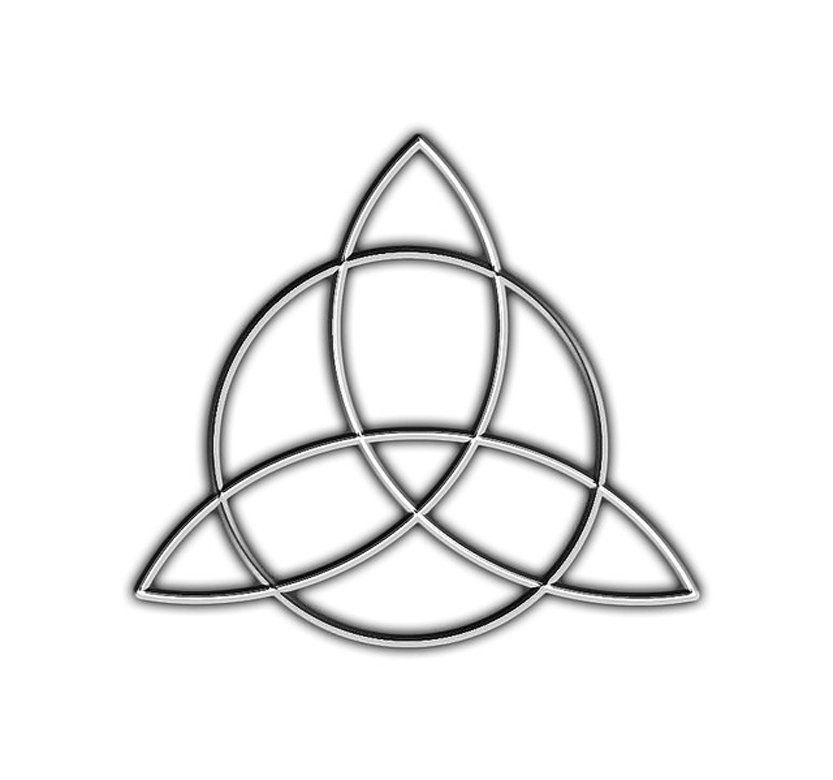
This is the source of all the swirls, whirls, and Möbius strips of creation.
And here’s the beauty: the Gospel isn’t just about God up there. It’s about the Father making room in the Son — and the Son opening space for us. Jesus prays, “Father, as You are in Me, and I in You, may they also be in Us.”
It’s not metaphor. It’s reality. The church is not a club. It’s a community pulled into the Triune life — an earthly echo of divine perichoresis.
***
John says the invisible God is now visible in Jesus. The Father is in the Son. The Son makes the Father known. And we — shockingly — are invited in.
Paul says the same. “In Christ,” he writes — over and over. Believers dwell in Christ, and Christ dwells in us. The Spirit wraps us in this divine embrace.
We are temples — houses for God’s Spirit. And at the same time, we are housed in Christ. “I in Thee, Thou in Me.” That’s the heart of the Good News.
The early church marveled at this. Hilary of Poitiers3Hilary of Poitiers (c. 310–367) was an early Christian bishop, theologian, and Doctor of the Church, often called the “Athanasius of the West.” As bishop of Poitiers in Gaul, he became a leading defender of Nicene Trinitarian theology against Arianism. Exiled for his opposition to Arian-aligned emperors, Hilary used his exile to deepen his theological work, producing major writings such as On the Trinity (De Trinitate). His efforts helped articulate orthodox teaching on the divinity of Christ in the Western church, and his legacy endures in both theology and hymnody., John of Damascus4John of Damascus (c. 675–749) was an Eastern Christian monk, theologian, and hymnographer, and one of the most important figures of Byzantine theology. Born into a Christian family under Islamic rule in Damascus, he later became a monk at the Monastery of Saint Sabas near Jerusalem. John is best known for The Fount of Knowledge, the first comprehensive systematization of Eastern Orthodox theology, and for his vigorous defense of the veneration of icons during the Iconoclastic Controversy. Drawing on the Greek Fathers and Aristotelian philosophy, his work helped preserve and transmit patristic theology, earning him recognition as a Doctor of the Church. — they wrote about this “containing and being contained” that no human reason could fully grasp.
But Leithart says — look around! This isn’t abstract. It’s in your breath, your body, your family, your songs. The Trinity leaves fingerprints on every inch of creation.
***
So what? What difference does this make?
First: it means love is the grain of the universe. Before anything was created there was loving community. So when we open ourselves — when we make room for others — when we dwell in each other’s lives — we live true. We follow the pattern.
Second: it means our faith isn’t about “balancing” opposites. It’s about embracing the tangle, the swirl, the co-dwelling. Trying to hold “individual” and “society” apart is silly — they make each other. Past, present, future — they interweave.
Third: it means the world is a house for God — and God is a house for the world. “In Him we live and move and have our being,” Paul said5Acts 17:28. The Triune God wraps the cosmos in love.
***
And the end of this story? It’s a wedding feast6Revelation 21 — when God and His people dwell together perfectly. A choir — when every voice fills the others with song. A temple — when Spirit and Bride echo the same note.
All the traces point here: Love is the source, the shape, and the goal.
***
So, friends — let the pattern sink in. You are not alone. You dwell, if you’re a believer, in Him — and He dwells in you.
And in this world, every breath, every chord, every loving embrace is one more whisper: “I in Thee, Thou in Me.”7John 14:20 & John 17:21-23
Until next time — keep listening for the traces.
The Trinity leaves fingerprints on every inch of creation.
***
Next – Episode 10 – Postscript
I welcome any questions or comments. [Don’t worry, your personal info will not be given to anyone.] Thanks!