
I encourage you to read as you listen. There are footnotes along the way defining unfamiliar words and providing some context for those who want to go a little deeper. (just click)
***
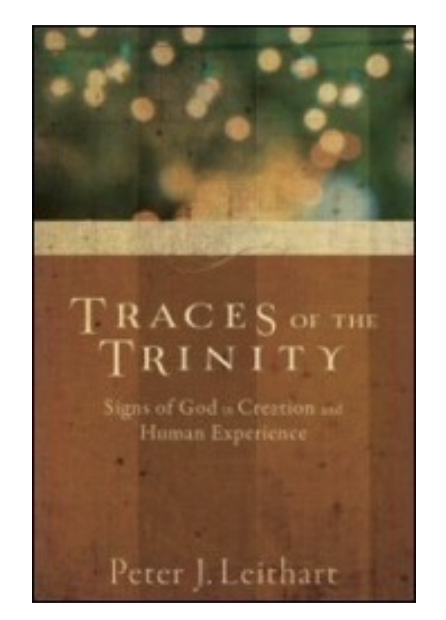
Welcome back to the podcast, today we are looking at Traces of the Trinity. If you’re just joining us — no worries. This episode stands on its own, but feel free to catch the teaser we did on the preface whenever you’d like.
So — today we’re stepping into Chapter 1 of Peter Leithart’s book, which he calls Outside In, Inside Out. And just like the title hints — this chapter is all about that fuzzy line between you and everything else.
+++
Let’s start simple. Look around. What’s near you? A desk, a mug, a window, a tree outside? Leithart does this too — he talks about his computer, his books, the couch he naps on, his daughter practicing piano in the next room. It’s all stuff. And in the middle of that stuff — is you.
Now, we’re used to thinking there’s a clean border between “me” and the “world.” Modern people inherited that mental map from René Descartes1René Descartes (1596–1650) was a French philosopher, mathematician, and scientist widely regarded as the father of modern philosophy. Seeking certainty in knowledge, he developed the method of systematic doubt, famously concluding “Cogito, ergo sum” (“I think, therefore I am”) as an indubitable foundation for philosophy. Descartes made major contributions to mathematics, including the creation of analytic geometry, which linked algebra and geometry. In metaphysics, he argued for mind–body dualism, distinguishing between thinking substance (res cogitans) and extended substance (res extensa). His most influential works include Discourse on the Method, Meditations on First Philosophy, and Principles of Philosophy. Descartes’ thought profoundly shaped modern philosophy, science, and rationalism.— remember him? The philosopher who got so tangled up in doubt that he had to convince himself, he at least existed — because he was thinking about whether he did.
It’s a clever trick: I think, therefore I am. But it set up this hard divide. Me in here, thinking. World out there, stuff. I’m mind — that’s matter. And modern folks still breathe this air. We often picture ourselves as brains driving a flesh robot through a landscape of objects.
+++
But here’s the twist. Leithart says — is that really how it works? Does that match how we live?
Think about it: you’re not just a mind floating above your body. You are your body. And your body is porous. Air goes in and out. Food, drink — we can’t survive without taking the world in. If the world doesn’t get inside you, you’re done for.
And it’s not just food and air. Light bounces off objects and enters your eyes. Smells slip in through your nose. Sounds vibrate your eardrums. Your skin is a two-way door — heat, touch, all of it. The world comes inside you every moment you’re alive.
And you give back, too. You exhale, sweat, speak, sing, cry. You’re constantly mixing with that “outside.”
+++
Leithart’s point is this: the sharp border between “inside” and “outside” is more like a fuzzy, breathing exchange. And when you see it that way — you start to notice: the world shapes you, and you shape it. There’s this continuous flow. In & Out.
He talks about how things are more than just lumps of matter. A coffee cup is a cup because it holds coffee. A window is a window because it opens a wall to light. The objects in your room are what they are because of their relations. The lamp isn’t just metal and wire — it lights up your desk, your book. The parts co-define each other.
So objects “indwell” each other. They overlap in function and meaning. And you — the thinking, breathing creature — indwell them, too. And they indwell you. It’s a mesh, not a barricade.
+++
This is where the Trinity connection starts to peek through. Remember that word from last time? Perichoresis — mutual indwelling. The Father in the Son, the Son in the Father, both in the Spirit.2Scripture addresses this theme of mutual indwelling most directly in John’s Gospel, where Jesus articulates the reciprocal relationship between himself and the Father. Jesus explicitly states that he exists within the Father while the Father simultaneously exists within him (John 14:10–11), a declaration he repeats for emphasis. He grounds this claim in the Father’s active presence—the Father dwelling within him performs the works Jesus accomplishes (John 14:10–11). This mutual indwelling serves as evidence of their unity, inviting belief through the works themselves (John 10:38). The relationship extends beyond the Father and Son to encompass believers and the Spirit. Jesus promises that his followers will come to understand a threefold union: he dwells in the Father, they dwell in him, and he dwells in them (John 14:20). This pattern of mutual presence becomes a model for Christian experience. In his prayer to the Father, Jesus envisions believers united with both the Father and Son, just as the Father and Son are united with each other (John 17:21). Regarding the Spirit specifically, Jesus promises the Holy Spirit as a Helper who will dwell with believers and ultimately be within them (John 14:16–17). While the scriptures don’t explicitly state all three persons simultaneously indwelling one another in a single passage, the Johannine material establishes the foundational theology: the Father and Son mutually indwell each other, believers indwell both through faith, and the Spirit indwells believers. Together, these passages construct a picture of trinitarian communion that extends from the Godhead into the church.
Leithart wants us to see: maybe this pattern isn’t just theology — maybe it’s stitched into how reality works. The world is full of co-living, co-shaping, co-indwelling things. Even solid matter — when physicists zoom in — turns out to be mostly empty space, held together by invisible forces.3This insight comes from modern atomic theory, which shows that what we call ‘solid matter’ is mostly empty space bound by fundamental forces. Nothing is fully sealed off.
Even us. We’re not islands. We’re knots in a web — threads passing through, looping back. The world makes us, we make the world.
+++
So next time you sip your coffee, look out the window, or feel the breeze on your arm — pause. Notice how much of the world is in you. And how much of you is in the world. That border is not a wall — it’s a door.
And maybe — just maybe — all these open doors echo the life of the Triune God, the original mutual indwelling that leaves its fingerprints on everything.
Next episode, we’ll keep going. We’ll look at what happens when this pattern shows up not just between things, but between people. The world is inside you — but so are others. And that, Leithart says, changes everything.
Until then — keep your pores open, your senses awake, and your mind alert for the hidden traces that surround you.
The Trinity leaves fingerprints on every inch of creation.
+++
2: Traces of the Trinity: Like Father, Like Son.
I welcome any questions or comments. [Don’t worry, your personal info will not be given to anyone.]