
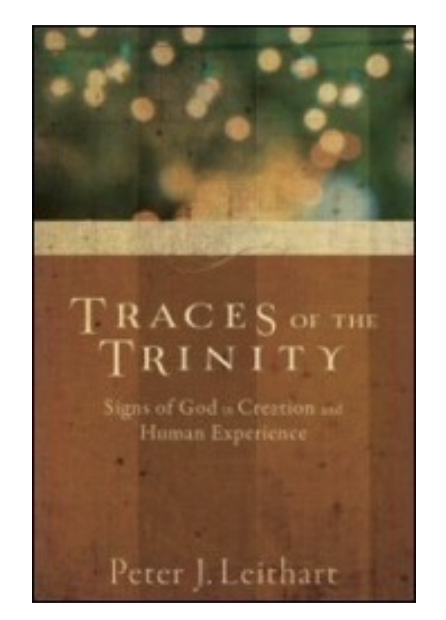
Hey friends — welcome back to the podcast. Today, we are hearing about Traces of the Trinity. So far, we’ve talked about our bodies, our families, our language, our sense of time — all these everyday things pointing us back to a deeper pattern of mutual indwelling.
Today, we tune our ears to something that may just be the clearest everyday clue that the universe hums with Trinitarian echoes: music.
This is Chapter 6 of Leithart’s book: Chords.
***
Leithart kicks this off with a few playful experiments. If you’re listening at home, try them sometime. First — look at someone nearby and shout! Not a gentle “Hey there” — a full-throated shout!!
They’ll jump. They’ll look confused. They’ll probably be annoyed. Why? Because sound moves — it crosses space. It connects what’s here with what’s there.
Sound, like smell, is presence in absence. You don’t need a clear line of sight — sound travels through walls, under doors, across fields.
***
Try another experiment: play some music in your room — your phone, a piano, a speaker. Then walk around. Face away from it. Lie down on the floor. Stand on a chair. Step into the next room.
You’ll notice something strange: the music is everywhere. The same notes fill the air above you, beside you, behind you. Unlike your eyes — which can only see what’s right in front of them — your ears pick up vibrations from all directions. The sound wraps around you.
***
Think about it. You can only see one side of your laptop at a time. You look at the front — the back disappears. You can’t see the whole thing in one glance.
But when you hear a song, you hear the whole chord at once. You don’t just catch one angle — the entire harmony pours through you.
Leithart says: sound fills space without taking up space. It occupies a room fully — yet leaves that same room open for everything else. The music and the chair and your cat and your coffee mug — they all share the same space.
And then there’s the magic of chords themselves. Hit a single note on a piano — say, middle C. That note is never alone. Hidden in that one sound are faint, ghostly overtones. Each note carries hidden passengers — other pitches that make it what it is.1Musical overtones are frequencies that occur above the fundamental (lowest) note when a musical sound is produced. They are natural vibrations that happen simultaneously with the main pitch and help determine the sound’s tone color (timbre). For example: If you pluck a guitar string tuned to C:
1. The whole string vibrates → C (fundamental)
2. The string vibrates in two halves → higher C (1st overtone)
3. The string vibrates in thirds → G (2nd overtone)
4. In fourths → higher C, and so on
These pitches follow a predictable mathematical pattern.
Play two or three notes together — a chord — and the miracle gets richer. Each note doesn’t push the others aside. They don’t compete for space. Instead, each note fills the whole soundscape — yet all coexist, intertwined. They resonate through each other.
***
Jeremy Begbie, a theologian and musician, says that when you hear multiple notes together, you’re hearing “mutual interpenetration.” That’s the fancy way of saying: no note shuts the others out. Each one makes room for the rest — and together they create something more than any single note could do alone.
It’s not just chords. A melody does this too — one note leans into the next. Think of a hymn or a favorite song. Each note is itself — but each depends on what came before, and what’s coming next.
A note that refuses to yield and make space? That’s not music — that’s noise.
***
Here’s where this touches the Trinity. Sound and music model mutual indwelling — perichoresis. Each part distinct — yet each part fully inside the others. All together, yet not collapsed into a blur.
Leithart says: this is more than poetic. For centuries, thinkers like the Pythagoreans2The Pythagoreans were an ancient Greek philosophical and religious movement founded in the 6th century BC by Pythagoras of Samos (c. 570–495 BC). They believed that number and mathematical harmony are the fundamental principles of reality and that the cosmos is ordered according to rational, numerical relationships. The Pythagoreans practiced a disciplined communal way of life that combined philosophy, mathematics, ethics, and religious ritual, including beliefs in the immortality and transmigration of the soul. Their ideas profoundly influenced Plato and the later development of Western philosophy, mathematics, and cosmology., Plato3Plato (c. 428–348 BC) was an ancient Greek philosopher and a student of Socrates, and one of the foundational figures of Western philosophy. He founded the Academy in Athens, the first long-lasting institution of higher learning in the West. Through philosophical dialogues such as The Republic, Symposium, and Phaedo, Plato explored ethics, politics, metaphysics, and epistemology, developing influential doctrines including the Theory of Forms, the immortality of the soul, and the vision of a just society ruled by philosopher-kings. His thought shaped virtually all subsequent Western philosophy, especially through his student Aristotle., and early Christian theologians saw music as a clue to the cosmos itself. The “harmony of the spheres” was the idea that the whole universe moves like music — ordered, relational, beautiful.
Music is order in motion. Unlike a statue or pyramid — frozen and rigid — music is alive. It’s always moving. It never stays still — yet it isn’t chaotic. It’s order made of flow.
Rowan Williams4Former Archbishop of Canterbury (Anglican). says that music teaches us about time too. Music forces you to wait. You can’t hear a whole symphony in an instant. You can’t jam all the notes on top of each other. You have to sit there, in time, receiving it moment by moment.
***
And that’s a gift. We often think of time as an enemy — ticking away, stealing youth, ending dreams. But music reminds us that transience — notes giving way — is what makes beauty possible. If every note refused to end, there would be no song.
Music shows us how to live in time — not as a prison, but as a dance.
***
Here’s another layer. Singing together makes this real in our bodies. If you’ve sung in a choir, you know: your voice doesn’t stand alone. Your sound blends into others. Your chest vibrates with the bass beside you, the soprano behind you. You dwell in their sound, and they dwell in yours.
Leithart says — this is society at its best: each person distinct, yet each one opening space for the other. Music is community made audible.
So next time you hum a tune, or feel goosebumps at a chord, or get swept away by a choir — remember: you’re feeling a living parable. A hint of the shape that holds everything together.
The world hums with chords — notes distinct yet dwelling in each other — a faint echo of the Father in the Son, the Son in the Spirit, the Spirit in the Father.
***
Next time, we’ll look at what happens when this pattern of making room spills out into how we live — how we love, lead, and open our lives to others.
Until then, may your days be filled with songs that remind you: the universe is not just atoms crashing in the dark — it’s a chord, a harmony, an invitation to listen deeper.
The Trinity leaves fingerprints on every inch of creation.
***
Next Episode 7 – Making Room
I welcome any questions or comments. [Don’t worry, your personal info will not be given to anyone.] Thanks!