Sex Rejection News – March 27, 2026

For years, we’ve been told that reality is flexible. That bodies can be redefined, language rewritten, and truth negotiated. This week suggests otherwise.

When Reality Pushes Back

There are moments in cultural history when reality—quietly, stubbornly—begins to reassert itself.

Not through sweeping revolutions.

Not through grand declarations.

But through court rulings.

Policy shifts.

Public backlash.

And, increasingly, ordinary people refusing to say what they know is not true.

This week offers five such moments.

Each one, in its own way, marks a small but significant crack in the illusion.


[1] The IOC Finally Acknowledges Reality
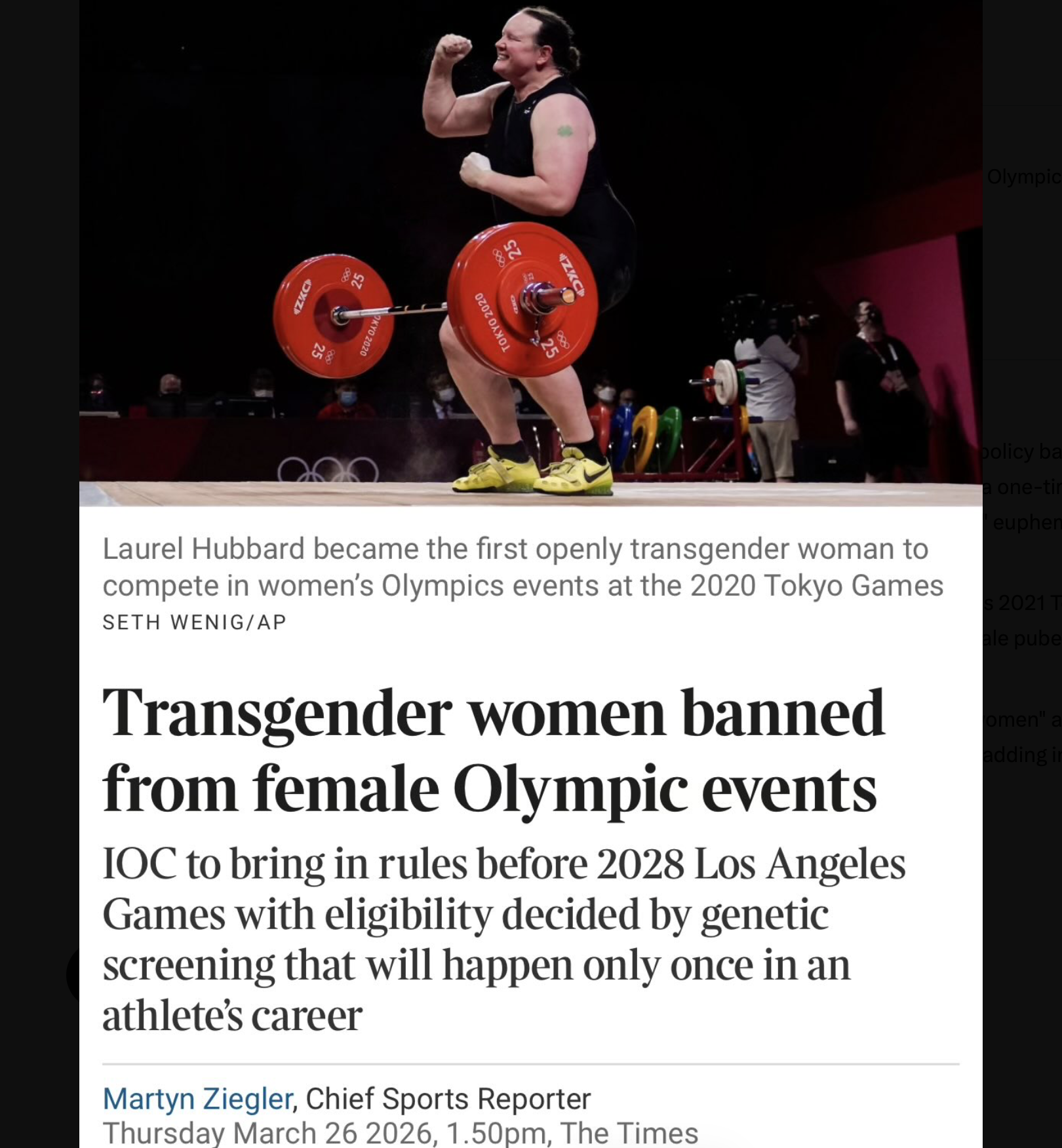
MEN are banned from female events - Get it right journalists!

After years of controversy, the International Olympic Committee has announced a policy change for the 2028 Games: eligibility for women’s events will be limited to biological females, determined through a one-time SRY gene screening.

Let’s be clear about what this means.

Despite the language used in much of the media—phrases like “transgender women”—this policy is about men competing in women’s sports. And now, finally, those men are being excluded.

Why the euphemisms? Why the linguistic fog?

The reality is straightforward:

Male puberty produces lasting physical advantages—greater muscle mass, bone density, cardiovascular capacity, and explosive strength. These are not erased by hormone suppression.

Even a 2021 British Journal of Sports Medicine review confirmed what most people instinctively understand: those advantages persist.

The IOC’s new policy simply acknowledges what should have been obvious all along:

If women’s sports are to exist at all, they must be protected as a category.

And contrary to predictable objections, the screening process is neither invasive nor demeaning. It’s a simple cheek swab—far less intrusive than procedures millions underwent routinely during COVID testing.

The remarkable thing is not the policy itself.

It’s that it took this long.


[2] A Teacher Wins—and Conscience Matters Again


In Indiana, teacher John Kluge has reached a $650,000 settlement after being fired for refusing, on religious grounds, to use students’ preferred pronouns.

This case—supported by Alliance Defending Freedom—highlights a growing tension:

Can the state compel speech that violates conscience?

Recent legislative responses suggest the answer is beginning to shift.

States like Idaho, Tennessee, and Wyoming have passed laws prohibiting schools from forcing teachers to adopt preferred pronouns. Idaho’s law goes even further, defining “social transition” to include names and pronouns—recognizing that language itself is not neutral, but formative.

This is not merely about politeness.

It is about whether reality can be spoken at all—or whether it must be replaced by enforced language games.

Kluge’s case suggests that, at least in some places, conscience is beginning to push back.


[3] A Father Loses Custody for Questioning Transition

Meanwhile, in Iceland, a deeply troubling case reveals the other side of this cultural divide.

A father has reportedly lost custody of his child after questioning the child’s gender transition.

(See analysis by constitutional law professor Jonathan Turley.)

Pause and consider what this means.

A parent—raising concerns about irreversible medical and psychological decisions involving his own child—is not merely disagreed with.

He is removed.

This is not a debate.

This is not persuasion.

This is coercion.

When the state begins to treat parental concern as a form of harm, something fundamental has shifted. The family—long understood as the primary unit of care and responsibility—is subordinated to ideological enforcement.

And the cost is borne by both parent and child.


[4] What Children Are Being Asked to Normalize

Across the UK, another controversy has erupted—this time over school reading lists that include books portraying children with “trans dads.”

On the surface, these may appear as simple attempts at inclusion.

But inclusion of what?

And at what age?

What we place in front of children—especially in formative years—is not neutral. Stories shape imagination. Imagination shapes belief. Belief shapes identity.

The question is not whether children should learn kindness.

Of course they should.

The question is whether they are being asked to normalize concepts they are not developmentally equipped to evaluate, and which adults themselves cannot coherently define.


[5] The Science That Refuses to Disappear

Finally, consider the underlying biology—often obscured in public debate but impossible to eliminate.

The female sports category exists for a simple reason:

Males and females are not physically the same.

Male development—driven by testosterone and androgenization—produces profound physiological differences:

  • Larger skeletal structure
  • Greater muscle mass and strength
  • Stronger connective tissues
  • Larger heart and lung capacity
  • Higher oxygen-carrying capability

These differences are not cosmetic.

They are decisive.

Even when testosterone is later suppressed, the structural advantages remain.

The video accompanying this post explains a proposed screening method: a simple cheek swab to detect the SRY gene, which initiates male development.

It is:

  • Non-invasive
  • Highly accurate (over 99.99%)
  • Cost-effective

And crucially, it allows for nuanced medical review in rare cases of developmental disorders—ensuring both fairness and compassion.

The key distinction is not identity.

It is whether male development occurred.

And that is a biological question, not a philosophical one.

Paradox Institute

Conclusion: Reality Is Not Indefinitely Negotiable

Taken together, these stories point to something larger.

For years, Western institutions attempted to redefine sex—not just socially, but materially.

Language was adjusted.

Policies were rewritten.

Dissent was discouraged.

But reality has a way of returning.

Not loudly, at first.

But persistently.

In courtrooms.

In legislatures.

In sports arenas.

And in the quiet recognition of ordinary people who simply refuse to say what they know is false.

If you only remember one thing from this week, let it be this:

Reality is patient—but it is not negotiable.

And sooner or later, it always reasserts itself.


The Christian tradition has always insisted that the body is not an accident, nor an enemy—but a gift, a given, and a truth to be received.

+++
Sex Rejection News – March 7, 2026

A Supreme Court Case Shows This Debate Isn’t Going Away

This past week a ruling by the Supreme Court in Mirabelli v. Bonta highlights just how deeply gender ideology is embedded in American culture. The case arose after California policies allowed schools to facilitate a student’s gender transition while keeping parents in the dark. Teachers and parents challenged the policy in court, arguing it violated both religious liberty and parental rights.

After years of litigation—moving through federal courts and all the way to the Supreme Court of the United States—the Court ruled 6–3 that such “gender secrecy” policies likely violate the Constitution and restored an injunction blocking them statewide. The Court emphasized that parents, not the state, are the primary guardians responsible for decisions about their children’s upbringing and mental health.  

One thing is clear: issues surrounding gender ideology are now deeply woven into schools, law, and public policy. The fact that disputes like this must be settled at the Supreme Court level shows that the debate will not disappear simply because one political party wins an election or two. This cultural conflict is likely to remain with us for years to come.

Courage.

Source: Thomas More Society


Truth Spoken at UN Human Rights Council Meeting

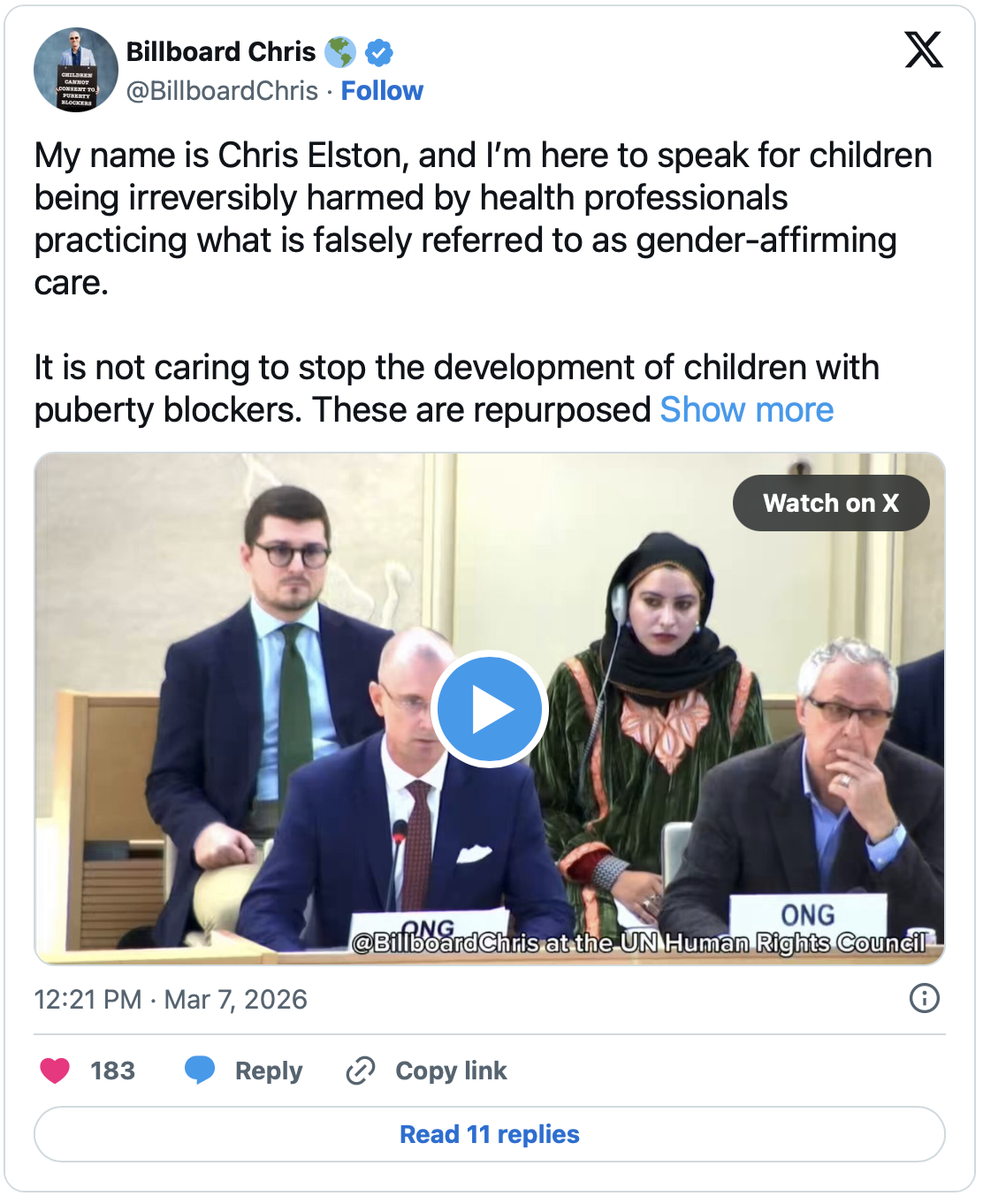
Speaking before the United Nations Human Rights Council this week, Chris Elston (Billboard Chris) argues that so-called gender-affirming care for minors is causing irreversible harm to children. He testifies truthfully that treatments such as puberty blockers, cross-sex hormones, and surgeries interfere with normal development, sterilize young people, and remove healthy body parts.

These practices are driven by ideological activism rather than sound science, and he describes them as an unregulated experiment on vulnerable children—many of whom have autism, mental health issues, or trauma histories. The compassionate approach is to affirm children as they are without medical intervention.

Elston also warns that government authorities are increasingly overriding parental rights in transition-related disputes and calls on United Nations member states to act to protect children’s right to grow up with their bodies intact.

View his speech here.


When Adults Let Children Define Reality

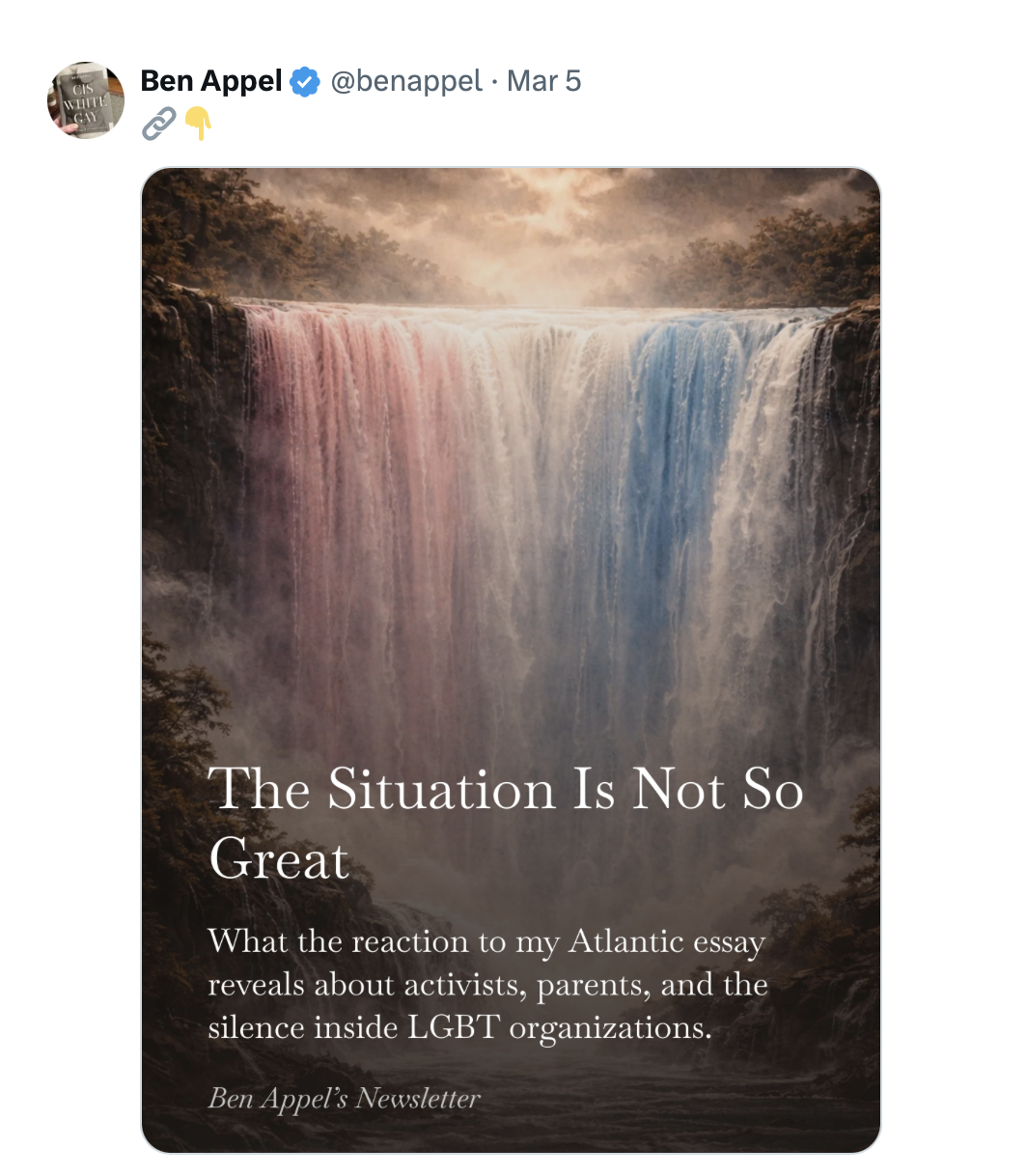
A recent Atlantic essay, “In Defense of Effeminate Boys,” argues that boys who display feminine traits should simply be accepted as a natural variation of the male sex—not pushed into rigid stereotypes or steered toward gender transition.

The author reports sharply divided reactions: harsh criticism from activist circles, but quiet support from many readers—including some inside LGBT organizations who privately share his concerns but feel unable to speak publicly.

At the center of the debate is what the author calls one of the most dangerous and consequential ideas in modern history: the belief that we must “let the kids lead.” In this view, a child’s declared gender identity overrides biological sex, and parents are expected to affirm it—even if it leads to medical interventions.

The deeper problem, he suggests, is that this reverses the role of parents. Instead of helping children understand reality, many adults now feel obligated to let children define it.


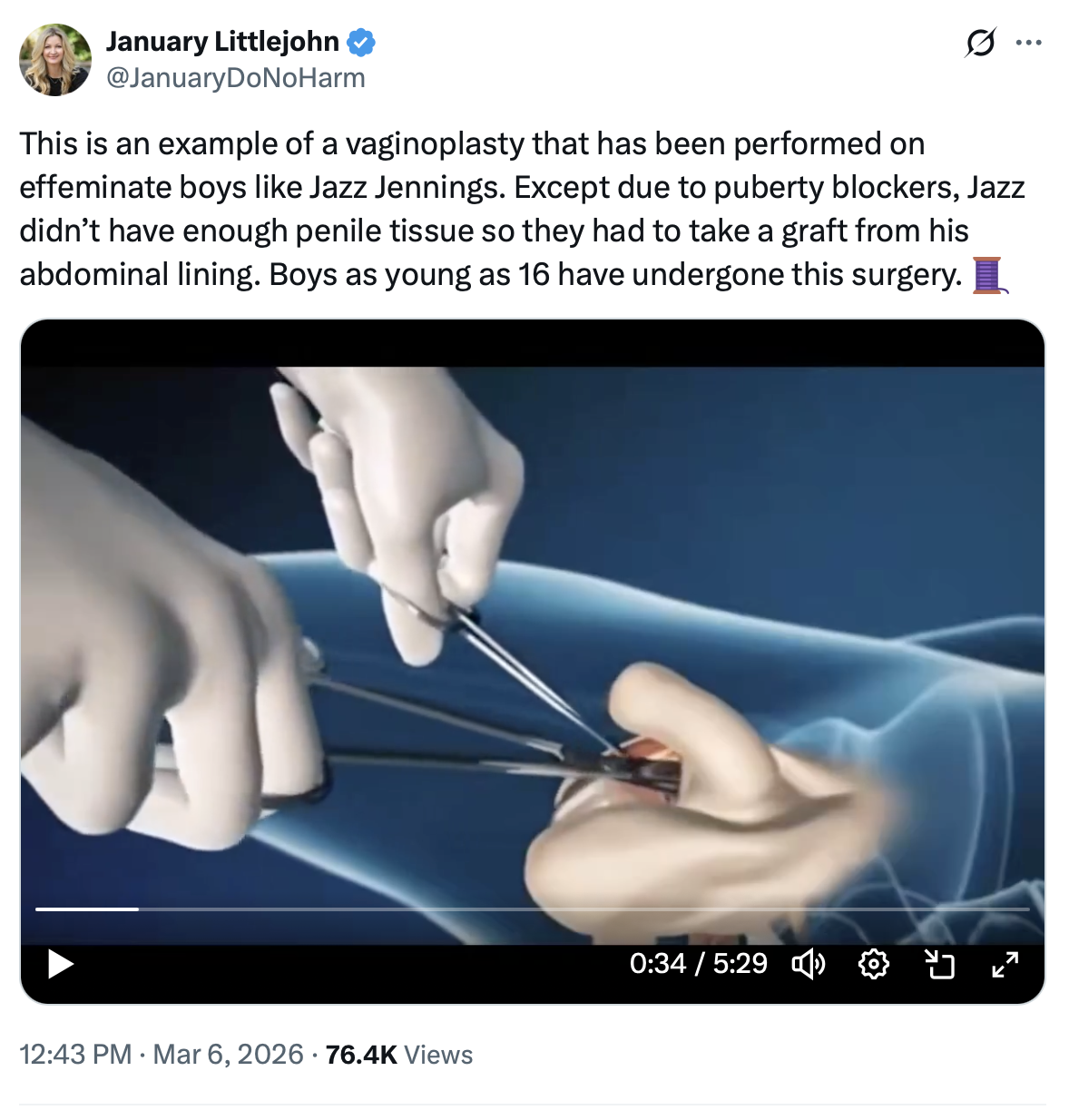
What are we doing to our children?

A video explains the madness.

Companion Post


More News on Page 2

Why Liberals Should Take the HHS Review Seriously

In a striking and carefully argued Newsweek editorial, bioethicist Moti Gorin and psychiatrist Kathleen McDeavitt urge liberals to reconsider their assumptions about pediatric “gender-affirming” medical care. Their appeal is unusual not because it is partisan, but because it is not: both authors identify as liberals and were contributors to the recent review issued by the U.S. Department of Health and Human Services titled Treatment for Pediatric Gender Dysphoria: Review of Evidence and Best Practices.

The authors begin by acknowledging widespread distrust of HHS—especially among progressives after years of controversy surrounding public health institutions. But they argue that skepticism should not excuse disengagement, particularly when the evidence concerns vulnerable children.

Their central claim is straightforward: many organizations and professionals trusted by the political left have embraced a medical model for pediatric gender distress that is not supported by strong scientific evidence.

A Fragile Foundation for a Sweeping Medical Practice

The editorial traces the origins of today’s “gender-affirming” approach to a small and methodologically weak Dutch study involving just 70 adolescents. Most of the participants were same-sex attracted, and all who proceeded to medical transition were rendered sterile. One patient died from surgical complications, others were excluded from analysis due to adverse outcomes, and some were lost to follow-up. Yet despite these limitations, the study became the foundation for a sweeping international medical practice involving puberty blockers, cross-sex hormones, and sometimes surgery.

Gorin and McDeavitt argue that serious ethical concerns have since been minimized or obscured. They note reports of unfavorable findings being buried, including completed suicides among minors placed on hormones. They also highlight the role of the World Professional Association for Transgender Health (WPATH), which removed age limits for medical interventions under political pressure while failing to warn patients about risks such as permanent sexual dysfunction.

The HHS review, the authors explain, reached conclusions that should alarm anyone committed to justice and evidence-based medicine. The risks documented in the review include infertility, impaired sexual function, decreased bone density, delayed cognitive development, and irreversible surgical consequences.


Progressive Countries Lead the Retreat

Importantly, the authors point out that this reassessment is not driven by conservative politics. Some of the first countries to restrict pediatric medical transition were progressive social democracies, including Finland and Sweden, followed by the United Kingdom. These nations conducted systematic reviews and concluded that the benefits of medical transition for minors were unproven and outweighed by the harms.

The editorial closes by proposing an alternative: non-medical therapeutic support that helps young people manage distress without rushing them into irreversible interventions. Most adolescents, the authors note, will see gender-related discomfort resolve over time. While the issue remains politically polarized, polling shows that a majority of Democratic voters already oppose pediatric medical transition.

Gorin and McDeavitt’s plea is simple but bracing: liberals should read the HHS review for themselves (link above). Doing so, they argue, is not a betrayal of progressive values—but an affirmation of them.

+++