When Telling a Child the Truth Becomes Suspect

Helen Joyce, the UK’s Conversion Practices Bill, and the problem of expressive individualism

Helen Joyce is one of the sharpest thinkers I’ve encountered on the subject of sex and contemporary identity politics. She has a remarkable ability to cut through complicated arguments and expose assumptions that others seem reluctant to question.

The accompanying three-minute video illustrates that ability beautifully.

On October 29, 2026, Joyce, representing the organization Sex Matters, testified before a joint committee of the British Parliament examining the government’s proposed Conversion Practices Bill.

Her testimony raises a question that ought to concern parents, clergy, therapists, and anyone who values freedom of conscience:

When did telling a child the truth become something the government might regard as abusive?

An Eleven-Year-Old Girl and Her Mother

Joyce asks the committee to consider an autistic eleven-year-old girl who identifies as non-binary. The child sincerely believes she is neither male nor female.

Her mother knows otherwise.

She knows her daughter is female, that she will undergo female puberty, and that her daughter’s feelings about her identity cannot alter those biological realities.

The mother may feel obligated to explain these things, even when doing so causes distress.

Joyce makes the essential observation:

“Her declaration, her words don’t make reality.”

Now suppose the mother restricts access to certain websites or friendships she believes are reinforcing her daughter’s confusion. The child becomes anxious, perhaps even refuses to attend school.

Has the mother engaged in abusive behavior? Or has she exercised ordinary parental judgment in a difficult situation?

Joyce’s concern is that the proposed legislation does not adequately distinguish between the two.

She offers another illustration. If a husband confiscates his wife’s telephone to isolate her from friends and family, that would constitute coercive control.

But if a mother temporarily confiscates her eleven-year-old daughter’s telephone to protect her from harmful influences, that is an entirely different matter.

Surely our laws must recognize the distinction.

What the Proposed Law Actually Says

The British government’s draft Conversion Practices Bill, published June 25, 2026, seeks to prohibit abusive efforts to change someone’s sexual orientation or transgender identity.

Protecting people from violence, intimidation, and genuine psychological abuse is an entirely legitimate objective.

But the legislation raises questions about what constitutes abuse.

Clause 1 includes conduct intended to cause someone to have, not have, or believe they have or do not have a particular sexual orientation or transgender identity.

In determining whether conduct is abusive, the bill directs attention to factors including controlling behavior and psychological or emotional pressure.

Clause 2 requires serious physical or mental harm, or serious alarm or distress substantially affecting everyday activities. The maximum criminal penalty is five years’ imprisonment.

The government insists that ordinary parenting, religious expression, and legitimate conversations would remain protected.

Nevertheless, the draft contains no explicit general exemption for parents exercising ordinary parental responsibilities. Nor does it provide an equivalent express protection for pastoral guidance.

And that is the concern Joyce and other critics are raising.

The proposed legislation also permits preventive protection orders, potentially bringing disputed conduct under judicial scrutiny without a prior criminal conviction.

The question is not whether genuinely abusive practices should be prohibited.

The question is whether the law distinguishes adequately between abuse and the legitimate responsibilities of parents, counselors, and religious leaders.

Children Need Guidance, Not Merely Affirmation

Children are not miniature adults.

We do not ordinarily treat their emerging preferences, convictions, or self-understandings as beyond question.

A child may sincerely believe something that is mistaken. A loving parent may be obliged to correct that belief, even when the correction is unwelcome.

This is particularly important when children experience distress concerning their developing bodies.

Therapists should be free to explore the possible sources of that distress without being required to reach a predetermined conclusion.

That means rejecting coercive attempts to force a particular identity upon someone. But it also means rejecting the opposite assumption that every declared identity must automatically be affirmed.

Genuine exploratory therapy should be free to explore.

The same principle matters in pastoral care. A priest or pastor should be able to discuss traditional Christian teachings about sexuality with someone voluntarily seeking that counsel, without unnecessary fear that the conversation itself will attract legal suspicion.

Compassion and honest disagreement are not mutually exclusive.

The Deeper Problem: Expressive Individualism

There is a larger philosophical issue beneath this controversy.

In The Rise and Triumph of the Modern Self, Christian historian Carl Trueman examines what he calls expressive individualism.

The concept, associated particularly with philosopher Charles Taylor, describes the modern conviction that our deepest identity is discovered within our psychological lives—our feelings, desires, and subjective experiences—and that authentic living requires outward expression of that inner identity.

In this worldview, personal authenticity becomes a central measure of human flourishing.

But consider the implications.

If my deepest feelings determine who I am, then someone who questions my self-understanding may appear to be doing more than disagreeing with me.

They may appear to be denying my very identity.

And if affirmation becomes a moral obligation, disagreement can be interpreted as psychological injury.

This helps explain why an ordinary parental conversation about biological sex can become so contentious.

What one person regards as a loving acknowledgment of reality, another may interpret as an attack upon personal identity.

We have moved from the proposition that people deserve dignity and respect to the untenable proposition that respecting someone necessarily requires affirming that person’s subjective understanding of reality.

Those are not the same thing.

The Christian Understanding of the Human Person

Christianity offers a fundamentally different understanding of human identity.

We are not self-created beings whose bodies are incidental to our deepest selves.

We are embodied creatures, made in the image of God—male and female, according to Genesis 1:27, and Jesus (Matthew 19:4).

The body is not an inconvenient biological shell surrounding the supposedly authentic person within.

Our bodies belong to who we are.

Indeed, the Christian story places extraordinary importance upon embodiment: Creation, the Incarnation, Christ’s bodily resurrection, and the promised resurrection of our own bodies.

This does not mean dismissing psychological suffering. Quite the contrary. Christians are called to respond with patience, compassion, and love.

But compassion does not require treating subjective experience as the final authority on reality.

And love sometimes requires telling someone something they do not want to hear.

Protecting Children Without Criminalizing Care

The proposed British legislation remains under parliamentary scrutiny. The joint committee is scheduled to report by January 22, 2027. Its final language and legal consequences remain uncertain.

That makes Joyce’s testimony especially timely. After having followed Joyce for many years now, (see here, here, here, & here), I unhesitatingly say; if she is concerned, I’m concerned.

A civilized society must protect vulnerable people from genuine abuse. But it must also preserve the freedom of parents to parent, therapists to investigate, and religious leaders to offer counsel consistent with their convictions.

None of those freedoms licenses cruelty or coercion.

But neither should they become casualties of legislation that fails to distinguish responsible guidance from abusive conduct.

Helen Joyce has identified a question that reaches well beyond Britain.

When a child’s subjective identity conflicts with biological reality, will parents and professionals remain free to discuss that conflict honestly and compassionately?

Or will the fear of being accused of abuse determine what they are permitted to say?

I encourage you to watch her three-minute testimony and consider what is at stake.


+++

When Oxford Bows Before the Sovereign Self


More evidence that our elite Western institutions are bowing the knee to the ideology of technologically assisted expressive individualism—unconstrained by God-designed reality.

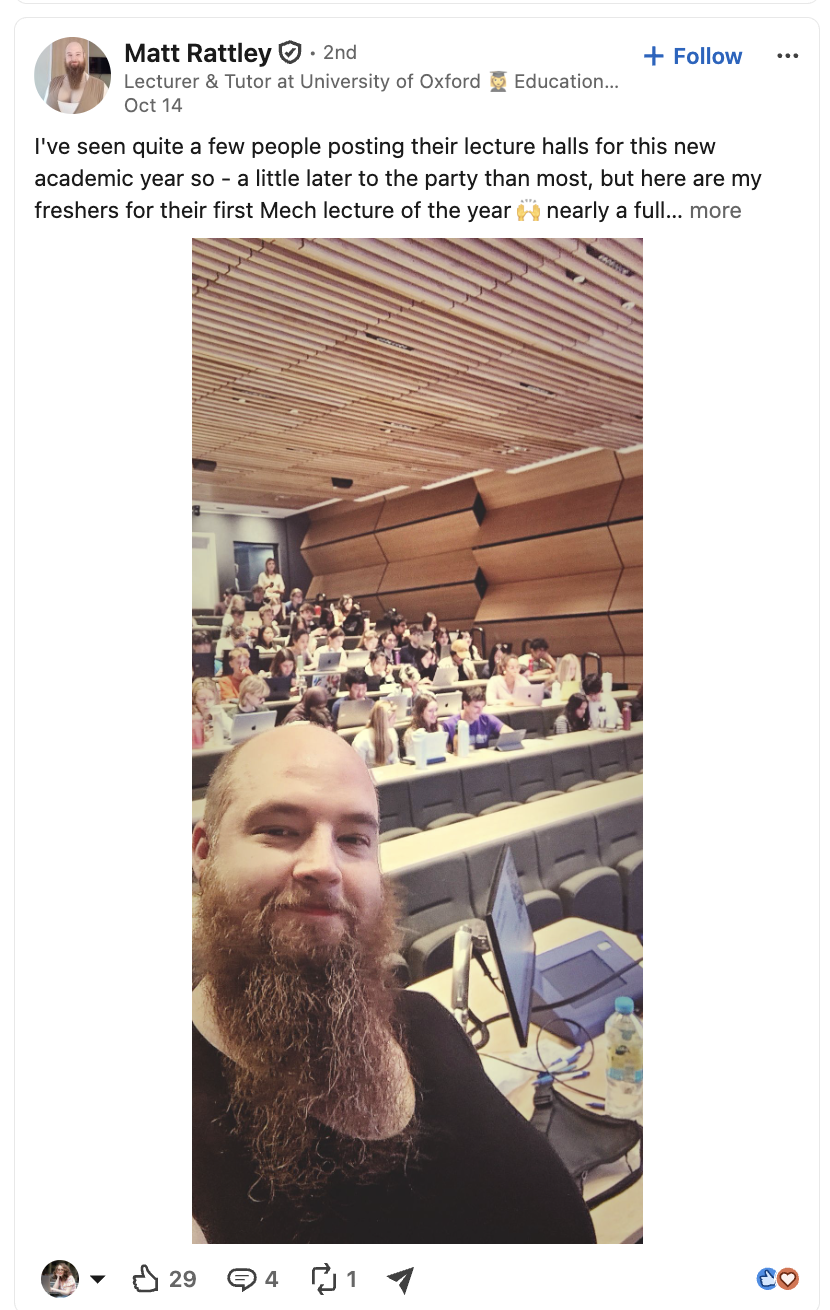
At Oxford University, a male biochemistry tutor continues teaching while wearing enormous prosthetic breasts. When questioned, Oxford emphasized its commitment to allowing members of its community to feel “able to be themselves,” while declining to comment on the individual case.

Consider what this represents.

We are witnessing the triumph of an ideology in which personal identity is increasingly detached from biological reality, the body becomes something to be technologically manipulated, and subjective self-expression takes precedence over objective truth.

Christianity offers a profoundly different understanding of human nature. We are embodied creatures, made male and female in God’s image. Our bodies are not meaningless biological accidents to be overcome but integral to our God-given humanity.

The troubling question is no longer simply what individuals choose to believe about themselves.

It is why institutions supposedly devoted to discovering and teaching truth increasingly appear unwilling to defend the reality of our created nature.

[Source: https://thisisuncaptured.com/male-oxford-university-tutor-still-wearing-prosthetic-breasts-to-work/ ]

+++

God Help Us!

When a Culture Loses Touch with Reality

Link – Imagine walking into your child’s classroom and this person is their teacher.

Mia Hughes begins her recent essay, “Trans Is a Mental Disorder,” with a deliberately provocative observation: Western society has normalized the idea that otherwise healthy people may require hormones, surgeries, and even the removal of healthy body parts in order to become psychologically whole.

For Hughes, the question is obvious: How did something once understood as evidence of psychological distress come to be regarded as a healthy expression of personal identity?

Her answer is that transgender medicine underwent a process of depsychopathologization. Rather than locating the problem in a person’s relationship to his or her sexed body, the emerging gender-affirming model increasingly located the problem in the body—or in society’s refusal to affirm the individual’s internal identity. Hughes argues that this transformation was heavily influenced by activism and eventually institutionalized in medicine, law, education, and popular culture.

Hughes then proposes a psychiatric category she believes helps explain the phenomenon: the overvalued belief.

An overvalued belief is not quite a delusion. The person may remain intelligent, competent, and perfectly rational in most areas of life. Nor is it an obsession, because obsessive thoughts are normally unwanted. Instead, an overvalued belief is deeply embraced. It becomes intertwined with identity itself and can eventually dominate how someone interprets reality.

Hughes compares the phenomenon to anorexia or body dysmorphic disorder. The sufferer may become convinced that some aspect of the healthy body must be changed. The conviction becomes so powerful that medical alteration appears not merely reasonable but necessary.

“Imagine a group of powerful, well-connected anorexics gather and formulate a plot to reject the psychiatric framing of anorexia and turn their illness into a healthy identity. They make it discrimination and bigotry to call anorexia a mental disorder and frame access to liposuction and Ozempic as medically necessary and a human right. The whole world goes along with this. In the field of anorexia-affirming care, an anorexic receives immediate affirmation of her anorexic identity and unfettered access to the weight-loss medical treatments that her disorder demands.

No psychotherapeutic attempt is made to loosen the grip of the belief.

Then, instead of measuring success by objective outcomes such as physical health and quality of life, researchers in the field opt for self-report: in other words, after giving the anorexic the very treatments that her disorder compels her to seek, the researchers ask her if she is happy. When she says yes, this confirms that Ozempic and liposuction are beneficial and appropriate treatments for anorexia. That is the medical world’s current approach to managing the trans phenomenon. Read how this madness happened in my first essay of @Genspect’s REPATH series.”

Source: Mia Hughes

Hughes’s analogy is intentionally jarring. But that is precisely why it is useful. It forces us to ask whether compassion requires affirming a person’s interpretation of his or her body—or whether genuine compassion requires challenging that interpretation. And for Christians, this question reaches deeper than psychiatry or medicine. It takes us directly into the biblical doctrines of creation, embodiment, truth, and ultimately the nature of spiritual deception.

The Body Is Not an Accident

The biblical worldview begins somewhere very different from modern expressive individualism.1Expressive individualism is the modern conviction that our deepest identity is found within our inner psychological self, and that authentic living requires expressing that inner identity outwardly and having it recognized by others. This helps explain contemporary sexual and gender ideology because the inner self is granted greater authority than the body. If the body and the psychological self appear to conflict, expressive individualism tends to say that the body must yield to the self.

“Male and female he created them.”

Our bodies are not raw material handed over to an ‘autonomous’ self that stands above them. The body participates in who the person is.

Abigail Favale of Notre Dame puts the matter helpfully when she describes male and female as two embodied ways of being human. Sexual difference is not merely a collection of stereotypes about personality. It is rooted first in the body itself. Men and women are equally human, equally bearers of the image of God, yet their bodies are meaningfully different.

Christianity therefore cannot accept the idea that the deepest self is somehow trapped inside the wrong body. That anthropology is remarkably close to the ancient dualisms Christianity rejected from the beginning (Gnosticism).

Creation matters.

The Incarnation matters.

And bodily resurrection matters.

God does not rescue human beings from embodiment. He redeems human beings as embodied creatures.

And Then There Are the Powers

But the biblical worldview goes further still.

Scripture does not describe evil merely in terms of mistaken ideas, psychological dysfunction, social systems, or individual sin. It also speaks about unseen powers—“principalities,” “powers,” “rulers,” and “authorities”—that work against God’s purposes for creation.

That does not necessarily mean that a person experiencing gender dysphoria is demon possessed. Nor should Christians casually assign demonic explanations to individual psychological suffering.

The point is larger.

The Bible tells us that deception itself has a supernatural dimension.

Spiritual warfare is fundamentally “a conflict between what is true and what is false.” The serpent’s strategy in Genesis 3 is not to create an entirely imaginary world. It is subtler. He takes what God has made and reframes reality, mixing truth with falsehood until human beings begin distrusting what God has said and what God has made.

That pattern should sound familiar.

“You will be like God,” the serpent says.

In other words: you may determine reality for yourself.

The modern version is remarkably similar: 

At that point we have moved beyond a debate about pronouns.

We are dealing with anthropology.

We are dealing with creation.

And ultimately we are dealing with authority.

Who gets to say what a human being is?

Idolatry and the Autonomous Self

One of the fundamental axioms of Biblical Theology is that human beings become like what they worship. Humanity was created to image God, but idolatry distorts that image. Instead of receiving reality from the Creator, fallen humanity turns toward created things—and, in the modern age, ultimately toward the self.

The modern ‘autonomous’ self can therefore become an idol.

The self no longer receives identity as gift. It manufactures identity through will.

The body says one thing.

The ‘autonomous’ self says another.

And increasingly the surrounding culture is required to declare that the self is right and the body is wrong.

That is why this controversy reaches far beyond the relatively small number of people suffering profound gender distress. It asks every one of us to embrace a particular understanding of reality: that personal identity originates primarily in subjective consciousness rather than in the created body. (See definition of expressive individualism above.)

From a biblical perspective, that reversal should trouble us deeply. (Unfortunately, this reversal does not trouble some Christian denominations!)

The People Are Not the Enemy

There is one final Christian qualification that is essential.

Paul tells us explicitly that “our struggle is not against flesh and blood.”

The transgender person is not the Christian’s enemy.

The confused teenager is not the enemy.

The frightened parent is not the enemy.

Even the activist advancing ideas we believe profoundly mistaken is ultimately not the enemy.

The Christian diagnosis of reality is simultaneously more severe and more compassionate than that.

Human beings can become caught inside lies larger than themselves. Institutions can reinforce those lies. Cultures can normalize them. And behind the biblical drama stands an older rebellion in which dark powers seek to deform God’s good creation by separating humanity from truth.

Yet Christianity does not end with the powers.

It ends with Christ.

The New Testament announces that Christ has already confronted, disarmed, and defeated the principalities and powers. The answer to deception is therefore neither hatred nor surrender.

It is truth joined to love.

We should have enormous compassion for people who experience anguish about their bodies. But compassion cannot compel us to claim that creation itself is mistaken.

Sometimes love means accompanying suffering.

Sometimes it means refusing to participate in a falsehood.

And sometimes the most compassionate sentence we can speak is very simple:

Your body is not your enemy.

+++

Celebrate God’s Good Creation