
“Our Goal Is Communism”: Reading the Democratic Socialists of America in Their Own Words

Part One: Beyond the Scandinavian Story
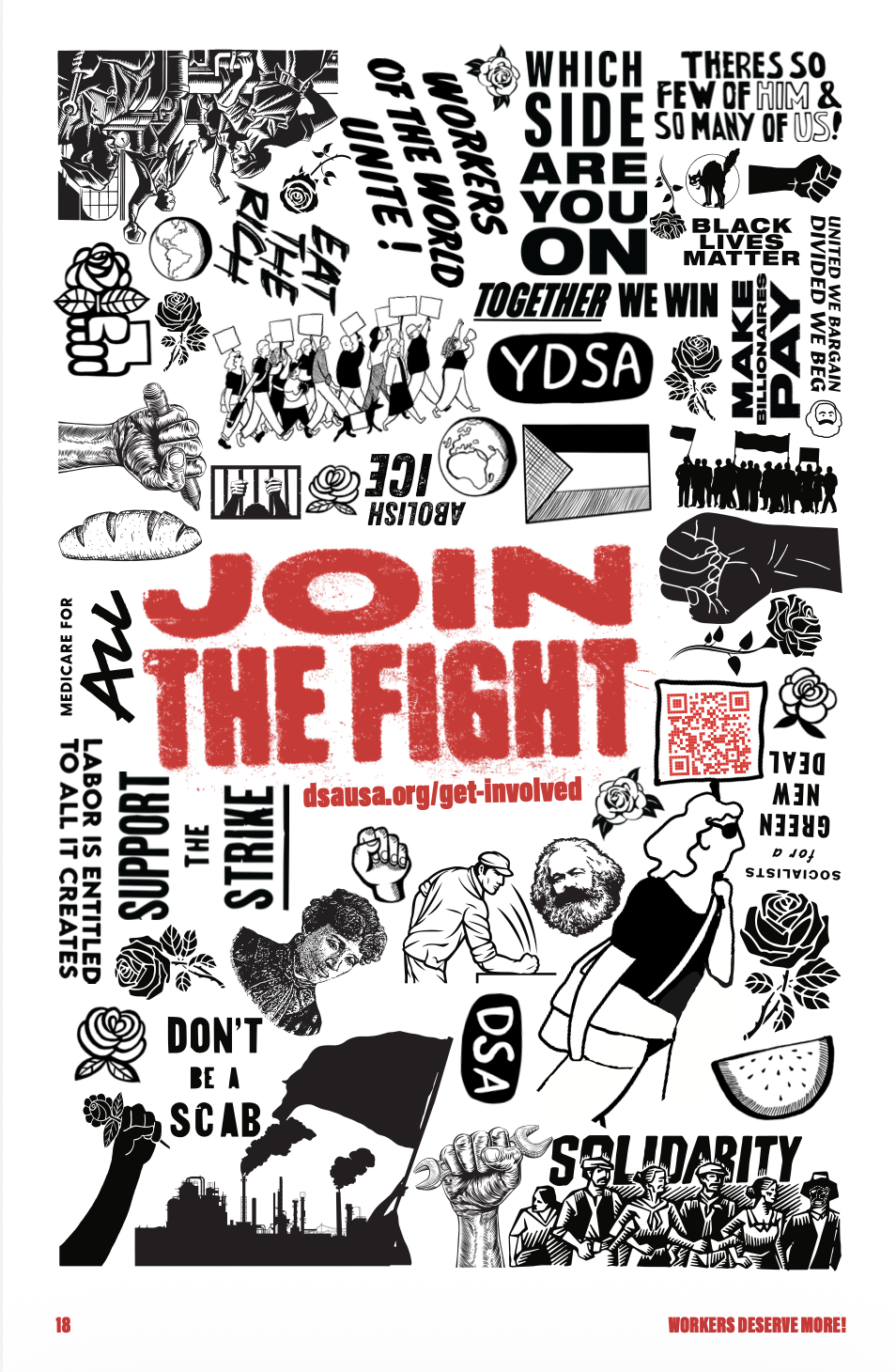

“Our goal is communism.”

—David Jenkins, Democratic Socialists of America leader

Audio – Reading the DSA in their Own Words – Part 1

When I first heard that statement, I assumed it had been taken out of context.

After all, Christians are routinely assured that today’s Democratic Socialists of America (DSA) is simply advocating a version of Scandinavian or Northern European social democracy: somewhat higher taxes, stronger labor protections, universal healthcare, expanded public investment, and a more generous social safety net.

One may agree or disagree with those policies, but they hardly resemble the revolutionary politics of the twentieth century.

Then I began reading.

Not conservative critiques.

Not cable news commentary.

Not campaign advertisements.

I began reading the Democratic Socialists of America’s own platform, convention documents, caucus literature, affiliated publications, and the writings of those who increasingly shape the organization’s leadership.

The deeper I read, the less David Jenkins’ statement sounded like an unfortunate rhetorical flourish.

Instead, it increasingly sounded like one of the few leaders willing to say publicly what many of the movement’s dominant factions already assume privately.

That realization prompted this essay.

Why This Matters

Readers of this blog know that I rarely write primarily about politics.

For several years I have tried instead to defend what I often call God’s Good Creation.

  • Marriage.
  • Family.
  • The sanctity of human life.
  • The meaning of the human body.
  • The created distinction between male and female.
  • The conviction that human beings flourish, not by inventing reality for themselves, but by gratefully receiving the created order as a gift from God.

Those concerns inevitably intersect with politics because politics increasingly attempts to redefine realities that Scripture and Christian tradition present as part of creation itself.

Politics, however, is never the starting point.

Ideas precede politics.

Worldviews shape ideas.

Theology ultimately shapes worldviews.

That is why Christians cannot evaluate political movements merely by asking whether they promise affordable housing, universal healthcare, better schools, or lower taxes.

Every political movement rests upon assumptions…

  • About human nature.
  • About justice.
  • About authority.
  • About freedom.
  • About the purpose of society.

Those assumptions matter.

Perhaps they matter more than the policies themselves.

The Comfortable Story

A recent exchange with a progressive Christian friend illustrates why I believe this conversation has become necessary.

She sent me an article by Christian writer Shawn Patrick Connelly defending democratic socialism against what he regarded as unfair conservative caricatures.

He writes:

That description is reassuring.

It is also increasingly common.

If this accurately described today’s Democratic Socialists of America, I doubt I would be writing this article.

Christians have debated the proper role of government for centuries.

Faithful believers disagree about:

  • Taxation.
  • Healthcare.
  • Labor policy.
  • Education.
  • Housing.
  • Immigration.
  • The size of the welfare state. (See previous blog post)

Those debates are important.

But they are prudential debates.

The Church has never required Christians to embrace one particular economic system.

My concern is different.

My concern is whether Mr. Connelly’s description still accurately describes the movement currently operating under the banner of the Democratic Socialists of America.

After reading its own literature, I no longer believe that it does.

Read Their Documents

Before going any further, let me make one promise.

This essay is not an attempt to resurrect Cold War rhetoric.

Nor is it an attempt to equate today’s Democratic Socialists of America with Stalin’s Soviet Union, Mao’s China, or Pol Pot’s Cambodia.

History deserves better than that.

The twentieth century witnessed horrors almost beyond comprehension.

Tens of millions perished under explicitly communist regimes. (See The Black Book of Communism.)

Nothing in this essay should trivialize those atrocities through careless historical comparison.

But there is an equal and opposite error.

We sometimes become so determined to avoid exaggeration that we fail to recognize genuine ideological change when it occurs.

Political movements should be evaluated, not primarily by the reassuring language they use when appealing to the general public, but by the ideas they teach, the goals they publish, and the convictions of those who increasingly lead them.

That is what I have attempted to do.

Whenever possible, I have relied upon the

  • DSA’s own documents.
  • Its own platforms.
  • Its own convention materials.
  • Its own affiliated publications.
  • Its own caucuses.
  • Its own leaders.

I encourage readers—especially my progressive Christian friends—to read the original sources for themselves.

Do not trust me.

Do not trust Fox News.

Do not trust MS NOW.

Read the documents.

Then decide.

DSA Documents


My argument rises or falls on whether these documents say what I claim they say.

A Different Conversation Than Most Americans Realize

One discovery surprised me more than any other.

Most Americans—including many Christians—continue assuming the principal debate surrounding democratic socialism concerns economics.

  • Capitalism versus socialism.
  • Markets versus government.
  • Private ownership versus public ownership.

Those questions certainly remain important.

But they are no longer the primary debate taking place inside today’s Democratic Socialists of America.

Increasingly, the debate concerns something else entirely.

It is no longer whether socialism should replace capitalism.

It is what kind of socialism should replace capitalism—and how revolutionary the movement should become.

That is a profoundly different conversation.

And it becomes obvious almost immediately once one begins reading the literature produced by the organization’s own caucuses.

Most Americans have never heard of organizations such as the Marxist Unity Group, Reform & Revolution, Red Star, Bread & Roses, or Socialist Majority.

Yet these organizations increasingly shape leadership elections, convention resolutions, ideological strategy, and the future direction of the Democratic Socialists of America.

More surprising still, they speak with remarkable candor.

Unlike political campaign literature written for the general public, these documents are written largely for fellow socialists.

The intended audience is not suburban swing voters.

It is committed activists.

As a result, the language becomes refreshingly honest.

Or perhaps alarmingly honest.

One caucus openly describes itself as a “revolutionary Marxist caucus.”

Another proudly traces its intellectual heritage to Marx, Engels, Lenin, Trotsky, and the Bolshevik tradition.1At its core, Bolshevism refers to the ideology and program of the Bolsheviks, which advocated violent overthrow of capitalism(1). But to really understand what that meant in practice, you need to know the historical context: Lenin led the Bolsheviks, a revolutionary faction that broke away from the Russian Social-Democratic Workers’ party in 1903, and they seized power in a nearly bloodless coup in November 1917(2).

What made Bolshevism distinctive wasn’t just its revolutionary goals—it was Lenin’s conviction about how revolution would happen. Lenin believed workers lacked the understanding to recognize their own interests, so they needed guidance from a disciplined “vanguard” party of revolutionaries(2). This wasn’t spontaneous uprising; it was revolution imposed from above by a committed minority.

In practice, Bolshevism became something far more totalizing than a simple economic system. It aimed to reshape the entire person through ideology, with the totality of human life as its scope, accomplished through centralized and highly organized power(3). Under Stalin, this evolved into Stalinism—notorious for totalitarianism, widespread terror, and the cult of personality surrounding Stalin as an infallible leader(2).

Interestingly, Bolshevism represents a state-centric approach to achieving social unity, grounded in what bureaucrats defined as historical necessity—essentially a rationalist interpretation of Russian communal traditions. So while it began as a response to genuine social injustice, the system that emerged became something radically different from its original ideals.

(1) Inc Merriam-Webster, in Merriam-Webster’s Collegiate Dictionary. (Springfield, MA: Merriam-Webster, Inc., 2003).
(2) COMPTON’S ENCYCLOPEDIA, s.v. “Communism.” (Copyright 2015 Encyclopaedia Britannica)
(3) Emil Brunner, “A Fresh Appraisal: The Cleveland Report on Red China,” Christianity Today (Washington, D.C.: Christianity Today, 1960), 4:15:604.

Another argues that socialists should work toward overthrowing the capitalist state.

Another calls for building a mass socialist party capable of fundamentally transforming American political life.

These are not descriptions authored by political conservatives.

These are self-descriptions.

That distinction matters.

Because it changes the question Christians ought to ask.

The question is no longer whether Scandinavian-style social democracy is compatible with Christian political thought.

The question is whether Christians have accurately understood the movement that increasingly calls itself democratic socialist.

I am no longer convinced that many of us have.

And once I began reading those internal documents, I found myself asking a different question altogether:

Who, exactly, is steering the Democratic Socialists of America today?

That is where the story becomes considerably more interesting.

[continue on next page]

Reality Restored: A Federal Court Upholds the Truth About Sex and the Human Body

On October 22, 2025, a federal judge in Mississippi handed down one of the most significant rulings yet in the legal struggle over “gender identity” mandates. In State of Tennessee et al. v. Robert F. Kennedy, Jr., Secretary of Health and Human Services, Judge Louis Guirola declared that the Department of Health and Human Services (HHS) had exceeded its statutory authority when it redefined “sex discrimination” to include “gender identity” under the Affordable Care Act.

The ruling does more than settle a technical dispute about regulatory authority. While the court’s purpose was to determine whether HHS exceeded its legal authority, its conclusion coincides with a deeper truth I affirm as a Christian — that our bodies are not social constructs or psychological projections, but part of the created order.

The law, in this instance, has returned to reality.


The Case: Tennessee v. HHS

In 2024, the Department of Health and Human Services issued a sweeping regulation titled “Nondiscrimination in Health Programs and Activities.” The rule reinterpreted “sex discrimination” to include five categories: sex characteristics, pregnancy, sexual orientation, gender identity, and sex stereotypes.

That redefinition would have required states, hospitals, and insurance providers that receive federal funds to cover or perform “gender-affirming care” — including puberty blockers, cross-sex hormones, and surgeries — regardless of conscience or medical judgment.

Fifteen states, led by Tennessee, sued. They argued that the rule went far beyond the authority Congress gave HHS in Section 1557 of the Affordable Care Act, which prohibits discrimination “on the ground prohibited under Title IX of the Education Amendments of 1972.” And as the court noted, Title IX’s meaning of “sex” is biological, not ideological.

The plaintiffs weren’t asking for special treatment. They were asking that federal law mean what it has always meant: that “sex” refers to male and female — not to self-declared identities.


What the Court Decided

Judge Guirola’s 26-page opinion is a model of clarity. He ruled that HHS’s 2024 rule:

  1. Exceeded its statutory authority under Title IX and the Affordable Care Act.
  2. Misapplied the Supreme Court’s Bostock v. Clayton County decision, which concerned employment discrimination under Title VII, not healthcare or education.
  3. Was unlawful in its entirety and therefore vacated nationwide.

The opinion states plainly:

“Congress only contemplated biological sex when it enacted Title IX in 1972. Therefore, the Court finds that HHS exceeded its authority by implementing regulations redefining sex discrimination and prohibiting gender-identity discrimination.”

The judge further held that the refusal to perform or cover procedures for “gender transition” is not discrimination “because of sex.” As he explained, if a doctor performs mastectomies for women with breast cancer but declines to perform them for patients with gender dysphoria, the distinction is not based on the patient’s sex but on the diagnosis itself.

In other words: medicine is about biology, not ideology.


Bostock Doesn’t Apply Here

The court’s analysis directly confronts HHS’s reliance on the Supreme Court’s Bostock ruling, which found that firing an employee for being homosexual or transgender violates Title VII’s ban on sex discrimination.

But Bostock explicitly limited its holding to employment law and said nothing about education, healthcare, or the broader cultural questions now before us. Title IX, unlike Title VII, contains explicit sex-based distinctions — for locker rooms, dormitories, sports teams, and bathrooms. Those provisions would be meaningless if “sex” were redefined to mean “gender identity.”

As Judge Guirola noted, interpreting “sex” as “gender identity” would create legal chaos. Schools could no longer maintain separate facilities for men and women. Sports competition would lose integrity. In the healthcare context, even legitimate medical distinctions — like sex-specific treatments — could be labeled “discrimination.”

That is precisely what the rule attempted to do, and why the court struck it down.


A Restoration of Constitutional Balance

Beyond the immediate issue of gender policy, this ruling restores a key principle of constitutional government: agencies do not have unlimited power to redefine law by executive fiat.

Quoting recent Supreme Court precedent (Loper Bright v. Raimondo), the court affirmed that statutes “have a single, best meaning fixed at the time of enactment.” Agencies are servants of Congress, not substitutes for it.

This is a vital reminder that the administrative state cannot function as an ideological laboratory for social experiments. The judiciary has begun to reassert the boundaries of delegated power, curbing the long pattern of executive agencies imposing cultural revolutions under the guise of “civil rights enforcement.”

The court’s language is unmistakable:

“Agencies do not have unlimited power to accomplish their policy preferences until Congress stops them; they have only the powers that Congress grants.”

That line deserves to be remembered.


Reality, Restored to Law

The court’s approach to statutory interpretation is refreshingly rooted in reality. Citing 1970s dictionaries, Judge Guirola observed that “sex” was universally understood to refer to biological distinctions between male and female. There was no concept of “gender identity” in 1972 law — because there was no such category in common understanding.

As simple as that sounds, it’s revolutionary in today’s legal landscape. The court refused to participate in the linguistic shell game that has corrupted public discourse. It chose to honor what words actually mean.


The Cultural and Moral Stakes

This case is not just about regulatory overreach or administrative law. It’s about truth-telling in a time of cultivated confusion.

For over a decade, we’ve watched federal agencies, medical institutions, and activist networks work to erase the distinction between man and woman — replacing embodied reality with subjective identity. In medicine, this ideology has demanded that doctors violate conscience, that parents affirm medical harm, and that the state compel participation in a collective fiction.


From a Christian Viewpoint: Creation and the Meaning of the Body

From a Christian perspective, this ruling affirms something far deeper than statutory interpretation. It affirms the created order.

Scripture tells us that humanity was made “male and female” (Genesis 1:27), and that this distinction is not arbitrary but sacramental — a sign of the divine image itself. As Notre Dame Professor Abigail Favale has written, the difference between man and woman “is not about completion, but communion.”

When law denies that created truth, it participates in what St. Paul called “the exchange of the truth of God for a lie.” The lie of our age is that the self is sovereign, that the body can be remade at will, and that nature itself must yield to the will of the autonomous individual.

This ruling marks a step back from that precipice.


Rejecting the New Gnosticism

Modern gender ideology, at its core, is a revival of the ancient heresy of Gnosticism — the belief that the material world is an obstacle to true identity, that salvation lies in self-knowledge detached from embodiment.

The court, perhaps without intending to, has reaffirmed the opposite: that embodiment is integral to who we are. Our bodies are not meaningless matter to be “corrected” by technology; they are the visible expression of the person God created.

When the judge wrote that Title IX’s use of “sex” referred to biological distinctions, he was defending more than a word. He was defending a vision of human integrity — one that law, medicine, and theology once shared.


Law and Compassion: Not Enemies but Allies

Critics will call this ruling “cruel,” claiming it denies care to transgender patients. But compassion severed from truth is not compassion — it’s abandonment. To affirm someone in a self-damaging illusion is to cooperate with harm.

True compassion tells the truth even when it hurts. The court did not deny anyone’s humanity; it denied the government’s power to redefine humanity.

Christians must remember: Love without truth is sentimentality. Truth without love is cruelty. But love in truth is the only path to healing.

This ruling doesn’t forbid care; it forbids coerced compliance with an untruth.


The Broader Implications

This decision will likely be appealed, but its reasoning aligns with the broader judicial trend of rejecting agency-driven redefinitions of “sex.” Other courts — particularly in the Fifth and Sixth Circuits — have already pushed back against the Biden administration’s interpretations of Title IX and the Affordable Care Act.

If upheld, the Tennessee ruling will shape how federal law treats sex distinctions in medicine, education, and beyond. It signals the end of a bureaucratic era in which ideology could rewrite biology by regulation.

For Christians and others who believe in the moral coherence of creation, this is not a moment for triumphalism but for thanksgiving and vigilance. The cultural pressure to conform to unreality will not disappear overnight. But truth has a way of resurfacing, and in this case, through the language of the law.


Conclusion: Living in the Truth

Judge Guirola closed his opinion with a reminder:

“Neither Defendants nor this Court have authority to reinterpret or expand the meaning of ‘sex’ under Title IX.”

The law is at its best when it reflects the created order rather than attempting to erase it. For years, American jurisprudence has been asked to pretend that male and female are mere social scripts. This ruling breaks that spell. For now.

In the words of St. Irenaeus, “The glory of God is man fully alive.” To be fully alive is to live in the truth of what we are — body and soul, male or female, created and loved by God.


Source: THE UNITED STATES DISTRICT COURT FOR THE SOUTHERN DISTRICT OF MISSISSIPPI

+++

Stay Human

Birthright Citizenship: Time for a Good-Faith Review

Yesterday, a good friend of mine—who is not a fan of the current administration—sent me links to two articles on the hot-button issue of birthright citizenship (see links below).

One was by Washington Post columnist Eugene Robinson, and the other by former NY Times columnist, Anand Giridharadas. Both passionately advocate for an “inclusive” birthright citizenship policy. However, Robinson accuses Trump—and by extension, anyone else questioning this policy—of racism.

President Donald Trump’s executive order purporting to abolish birthright citizenship is unambiguously and profoundly racist. We can conclude only that this is the whole point. The order plainly violates the Constitution and seeks to overturn crystal-clear Supreme Court precedent.

Eugene Robinson

I’ve followed Eugene Robinson’s work at The Washington Post over the years and am well acquainted with his point of view. I’ve always enjoyed reading his perspective, even when I disagree—which I often do. I believe we should all strive to consider perspectives from commentators and media voices that differ from our own. Over the years, I’ve made this a personal habit.

A central theme in Robinson’s writing is race, often framed as a critique of Republican policy initiatives. This is especially true when discussing Donald Trump, a politician who, to be fair, provides ample material for criticism. But in the debate over birthright citizenship, Robinson and others who take a similar approach reduce a complex legal and policy issue to a simplistic “crystal-clear” narrative centered on race. And that’s wrong.


Our allies ‘across the pond’ in the United Kingdom disagree with Robinson on this issue. Would he call their policy racist?

The British Nationality Act (1981)

The British Nationality Act 1981 fundamentally reshaped the UK’s approach to birthright citizenship by ending the principle of unconditional jus soli–the principle that anyone born on their soil automatically becomes a citizen. Prior to 1983, anyone born on British soil automatically acquired citizenship, regardless of their parents’ immigration status. However, this changed with the 1981 Act, which took effect on January 1, 1983, and established new eligibility requirements for citizenship by birth. Under the revised law, a child born in the UK is only automatically granted British citizenship if at least one parent is either a British citizen or legally settled in the UK with indefinite leave to remain or permanent residency. Importantly, the law was not retroactive, meaning that those born in the UK before 1983 retained their citizenship, but children born afterward became subject to the new rules. Additionally, the 1981 Act explicitly excluded children of diplomats from birthright citizenship, aligning with international norms by recognizing that such individuals are not subject to British jurisdiction. These legal changes reflect the UK’s deliberate move away from automatic citizenship by birth, reinforcing the principle that nationality should be tied to legal status and long-term commitment to the country rather than merely birthplace.

Most of our allies in the developed world do not recognize unrestricted birthright citizenship. Would Robinson argue that their policies stem from racial animus? The fact is, the United States is an outlier in this regard, and there is ample reason for a good-faith discussion about whether this policy continues to serve the national interest.

Trump, whatever one may think of him, is trying to invite a reasonable legal challenge to a policy that has gradually evolved beyond its original intent (see argument below).  To frame such a challenge as inherently racist, as Robinson does, is both untruthful and harmful to public discourse. If we’re ever going to have real discussions about immigration, national identity, or any other important issue, we need to drop the automatic cries of racism and focus on the actual arguments.

I believe Mr. Robinson overlooks crucial aspects of the history and legal rulings surrounding birthright citizenship in the United States. With that in mind, here is my more detailed perspective on the issue that moves beyond reflexive accusations.

The Historical and Legal Foundations of US Birthright Citizenship

Lawmakers drafted the Fourteenth Amendment in 1868 to secure citizenship rights for freed slaves, ensuring they were recognized as full members of American society. However, its phrasing—”All persons born or naturalized in the United States, and subject to the jurisdiction thereof, are citizens”—has since been debated in contexts beyond its original intent.

The drafters of the amendment did not intend to extend citizenship to children of foreign nationals without full legal allegiance to the United States. The 1866 Civil Rights Act, which laid the groundwork for the Fourteenth Amendment, explicitly granted citizenship to “all persons born in the United States, and not subject to any foreign power.” This wording suggests that Congress sought to exclude from automatic citizenship those whose parents owed allegiance to another country.

Misinterpretation of Wong Kim Ark

Proponents of universal birthright citizenship (the more inclusive kind) often cite United States v. Wong Kim Ark (1898) as definitive proof that the Fourteenth Amendment guarantees citizenship to all children born on U.S. soil. However, this is a misreading of the case. Wong Kim Ark concerned the U.S.-born child of legal permanent residents, not of undocumented immigrants or temporary visitors. The ruling did not directly address the modern issue of birthright citizenship for children of illegal aliens.

Further, early Supreme Court decisions like Elk v. Wilkins (1884) held that being born within U.S. territory was not sufficient for citizenship; one had to be fully subject to the country’s jurisdiction, meaning complete political allegiance.

Practical and Policy Implications of Birthright Citizenship

Unlike the United States, most developed nations have restricted or eliminated automatic birthright citizenship. I’ve already mentioned the UK. Other countries like France and Germany once granted citizenship based on jus soli—the principle that anyone born on their soil automatically becomes a citizen—but later abandoned it due to concerns over abuse and unintended consequences. The U.S. remains one of the few advanced economies where individuals can acquire citizenship simply by being born on its soil, regardless of their parents’ legal status.

This policy creates incentives for illegal immigration, as individuals recognize that having a child in the U.S. can provide an anchor for legal status and benefits. The term “birth tourism” describes cases where foreign nationals travel to the U.S. specifically to give birth, securing citizenship for their children despite having no lasting ties to the country.

The Moral and Cultural Counterarguments

Many contend that birthright citizenship defines American identity. Anand Giridharadas, in his article “The Idea of Birthright Citizenship,” presents an emotional and cultural argument: that America is a nation of becoming, defined not by blood or lineage but by inclusion. He contrasts this with European countries that define citizenship by ancestry, arguing that America’s model is superior because it embraces newcomers as equals from birth.

While compelling, this vision overlooks the crucial role of legal processes in maintaining a functioning nation-state. Immigration is a cornerstone of American success, but it should be orderly and lawful, ensuring that new citizens share the values and responsibilities of the country they join. A system that effectively rewards illegal entry undermines this principle.

The Path Forward: A Balanced Approach

Rather than maintaining universal birthright citizenship, the U.S. should adopt a policy that ties birthright citizenship to legal status. A possible approach:

  • Citizenship should be granted at birth only if at least one parent is a U.S. citizen or lawful permanent resident.
  • Children of non-citizens could be eligible for citizenship through a streamlined naturalization process, rather than automatically.
  • Clear guidelines should be established to prevent birth tourism and other abuses while maintaining protections for those who come to the U.S. legally and contribute positively.

Supreme Court Direction

For decades, birthright citizenship has expanded far beyond its original intent, not through congressional action or explicit judicial precedent, but through administrative policy creep. This drift occurred “silently through the back door” because executive agencies and immigration authorities passively adopted an overly broad interpretation of the Fourteenth Amendment, rather than enforcing it as originally understood. Courts, too, have failed to clarify the issue, allowing bureaucratic inertia to dictate a policy that was never explicitly sanctioned.

It is not the role of unelected officials to redefine constitutional meaning through gradual reinterpretation, yet that is precisely what has happened. The Supreme Court must finally take up this case and settle the matter—preferably by reaffirming the original intent of the amendment, as was written and understood by its framers.

This, I believe, is Trump’s intent with this controversial executive order (he’s had a few!).

Conclusion – Returning to the Personal

This debate is about more than legal technicalities—it’s about how America defines itself. Is citizenship a mere accident of birth, or is it a commitment to a shared national identity and legal order?

I respect those who argue passionately for universal birthright citizenship, and I understand their concerns about exclusion and fairness. However, America’s history and legal traditions argue that citizenship should be reserved for those who are truly part of the nation, not extended indiscriminately.

At the very least, this is a debate worth having, rather than allowing bureaucratic reinterpretation aided by a few lower court decisions to override the original meaning of the Constitution. The Fourteenth Amendment must be understood as it was intended by its framers, not reshaped to fit modern political preferences. In that light, we should critically examine whether birthright citizenship, as currently applied, aligns with the amendment’s original purpose and serves the best interests of the country and its future generations.

Debating birthright citizenship is a matter of law and principle, not racism.

Sources:

Richard Epstein – The Case Against Birthright Citizenship (Legal scholar, Laurence A. Tisch Professor of Law at NYU School of Law)

Amy Swearer & Hans von Spakovsky – Birthright Citizenship Clause Too Many Forget, But Trump is Right to Question (Legal and policy experts at The Heritage Foundation)

Eugene Robinson – The Real Reason Trump Wants To End Birthright Citizenship (Pulitzer Prize-winning columnist at The Washington Post)

Anand Giridharadas – The Idea of Birthright Citizenship (Author and political analyst, former New York Times columnist)

+++