
Hello, everyone. I hope you had a good Sabbath yesterday.
I spent the worship hour yesterday at our old church in Wake Forest, North Carolina. It’s one of the most culturally diverse churches I’ve ever attended. Some four thousand families worship there on a typical Sunday. And when we stand to say the Nicene Creed, we’re saying together what we believe.
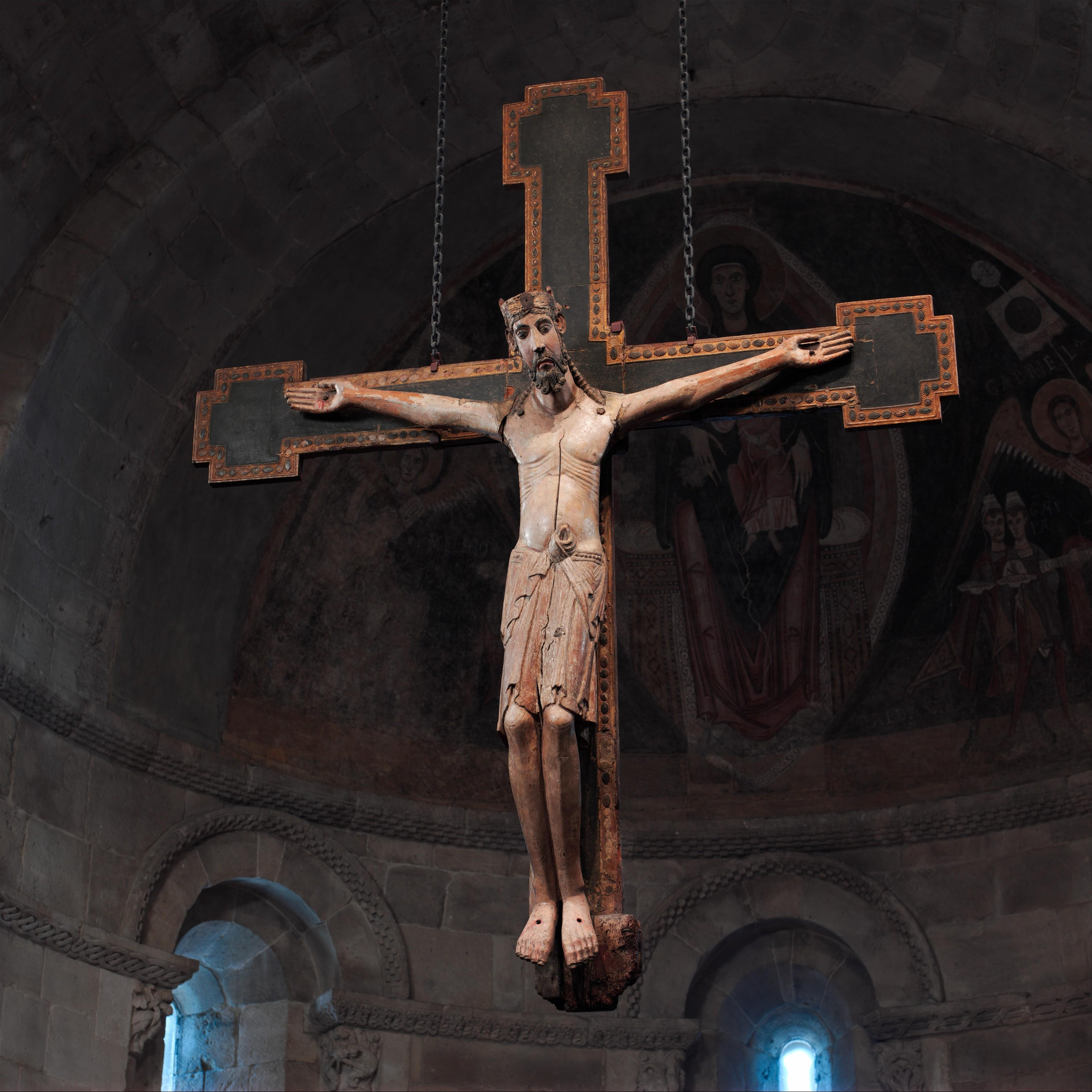
Today was Christ the King Sunday, the last Sunday of the church year. Our church leaders spoke plainly about what we were there to celebrate. Jesus Christ is King of the universe. His royal title was posted over his head on a Roman cross, of all places. Three days later, God raised him bodily from the dead. He ascended in that same humanity, and at this very moment he sits at the right hand of the Father as our priest and king.
I keep coming back to that last part. A human being sits at the right hand of God. The eternal Son took on our humanity for good. The Jesus who reigns today is the same Jesus who washed his disciples’ feet and showed them his wounds after the resurrection.
What kind of king does that?
Jesus knew how rulers used their power. They “lord it over” their subjects, he told his disciples. Then he said, “It shall not be so among you.” You want to know how authority works in my kingdom? Look at the Son of Man. He came to serve and to give his life for others. (Matthew 20:25–28)1But Jesus called them to him and said, “You know that the rulers of the Gentiles lord it over them, and their great ones exercise authority over them. 26 It shall not be so among you. But whoever would be great among you must be your servant, 27 and whoever would be first among you must be your slave, 28 even as the Son of Man came not to be served but to serve, and to give his life as a ransom for many.”
There’s a moment in Revelation that brings this home for me. John hears that the Lion of the tribe of Judah has conquered. He turns and sees a Lamb standing as though it had been slain. The Lion really has conquered, and the wounds of the Lamb show us how. (Revelation 5:5–10)2And one of the elders said to me, “Weep no more; behold, the Lion of the tribe of Judah, the Root of David, has conquered, so that he can open the scroll and its seven seals.”
6 And between the throne and the four living creatures and among the elders I saw a Lamb standing, as though it had been slain, with seven horns and with seven eyes, which are the seven spirits of God sent out into all the earth. 7 And he went and took the scroll from the right hand of him who was seated on the throne. 8 And when he had taken the scroll, the four living creatures and the twenty-four elders fell down before the Lamb, each holding a harp, and golden bowls full of incense, which are the prayers of the saints. 9 And they sang a new song, saying,
“Worthy are you to take the scroll and to open its seals, for you were slain, and by your blood you ransomed people for God from every tribe and language and people and nation, 10 and you have made them a kingdom and priests to our God, and they shall reign on the earth.”
This is what human kingship looks like when Jesus sets it right. Here is David’s heir, the truly human ruler we were meant to have. He uses his power to serve. He judges evil and sets right what it has broken. His reign brings us and the whole creation toward what God made us to be.
And who is this human king? Paul tells the story in Philippians 2. The one who shares in God’s glory takes the form of a servant, humbles himself all the way to death on a cross, and is exalted so that every knee will bow and every tongue confess that Jesus Christ is Lord.
Hebrews makes the same point in a few lines. The Son is the radiance of God’s glory. He makes purification for sins and sits down at God’s right hand. When we worship Jesus, we worship the eternal Son who became one of us and reigns as one of us. (Philippians 2:5–113Have this mind among yourselves, which is yours in Christ Jesus, 6 who, though he was in the form of God, did not count equality with God a thing to be grasped, 7 but emptied himself, by taking the form of a servant, being born in the likeness of men. 8 And being found in human form, he humbled himself by becoming obedient to the point of death, even death on a cross. 9 Therefore God has highly exalted him and bestowed on him the name that is above every name, 10 so that at the name of Jesus every knee should bow, in heaven and on earth and under the earth, 11 and every tongue confess that Jesus Christ is Lord, to the glory of God the Father.; Hebrews 1:3–44He is the radiance of the glory of God and the exact imprint of his nature, and he upholds the universe by the word of his power. After making purification for sins, he sat down at the right hand of the Majesty on high, 4 having become as much superior to angels as the name he has inherited is more excellent than theirs.)
Jesus before Pilate, Muhammad at Medina
This is where I find a fundamental difference between Christianity and Islam. It has to do with both who Jesus is and how he reigns.
When Jesus tells Pilate, “My kingdom is not of this world,” he gives Pilate a way to see what he means. If his kingdom came from this world, his followers would be fighting to keep him from being handed over. Jesus stands before the Roman governor and bears witness to the truth, knowing where it will lead. That has consequences for public life. If Jesus is Lord, every ruler and every government answers to an authority higher than its own. And the King himself shows his followers how to bear witness to his reign. (John 18:33–38)5So Pilate entered his headquarters again and called Jesus and said to him, “Are you the King of the Jews?” 34 Jesus answered, “Do you say this of your own accord, or did others say it to you about me?” 35 Pilate answered, “Am I a Jew? Your own nation and the chief priests have delivered you over to me. What have you done?” 36 Jesus answered, “My kingdom is not of this world. If my kingdom were of this world, my servants would have been fighting, that I might not be delivered over to the Jews. But my kingdom is not from the world.” 37 Then Pilate said to him, “So you are a king?” Jesus answered, “You say that I am a king. For this purpose I was born and for this purpose I have come into the world—to bear witness to the truth. Everyone who is of the truth listens to my voice.” 38 Pilate said to him, “What is truth?” After he had said this, he went back outside to the Jews and told them, “I find no guilt in him.
Muhammad exercised a different kind of authority. Muslims honor him as God’s messenger. At Medina he also led a political community and personally commanded men in battle. His victory at Badr strengthened that community’s position. Put that moment beside Jesus before Pilate. At Badr, military victory helped secure the early Muslim community. Before Pilate, Jesus says his servants would fight to save him if his kingdom drew its authority from this world. Then he goes to the cross.
The difference goes deeper than the two men’s exercise of authority. The Qur’an honors Jesus as Messiah and a messenger of God, and it rejects the claim that God has a Son. It also says that Jesus’ enemies neither killed nor crucified him. The very event Christians remember as the place where our King gave his life for us is an event Muslims deny.
That’s what I found myself thinking about after church today. The man on the cross is the eternal Son of God. He gave his life for the world. He rose bodily from the grave. And the hands that bear the marks of the nails are the hands in which God has placed the rule of the world.
+++