
Given how recklessly the words fascist and Nazi are thrown around these days, I thought it might be helpful to remind ourselves what those words actually mean. They are not interchangeable political insults. They describe identifiable political ideologies with distinct histories, objectives, and governing principles.
The essential distinction is pretty straightforward: Fascism seeks to revive and glorify the nation, while Nazism seeks to accomplish that through racial supremacy and racial purification.
But neither fascism nor Nazism can be adequately defined simply as strong government, nationalism, authoritarianism, or political intolerance. Those characteristics can be found in other political systems as well.
What distinguishes fascism is its revolutionary commitment to ultranationalism and national rebirth.
What distinguishes Nazism within that ideological family is its obsession with race and racial supremacy.
These are important historical distinctions. We shouldn’t abandon them simply because someone finds it politically expedient to do so.
Do Today’s Anti-Fascists Understand Fascism?
Which brings me to today’s self-described anti-fascists, particularly those on the radical Left who engage in violent protests against Trump and ICE while chanting slogans like “Free, free Palestine.”
I wonder how many actually understand what fascism means.
Opposition to immigration enforcement is not, by definition, opposition to fascism. Neither is opposition to a Republican president. And engaging in political violence while calling oneself an anti-fascist hardly establishes one’s commitment to liberty!
Fascism is a revolutionary, ultranationalist ideology, exemplified by Benito Mussolini’s Italy. Mussolini captured his conception of state supremacy in a memorable declaration:
“Everything in the State, nothing outside the State, nothing against the State.”
That is a rather specific political vision. It is not a synonym for conservative politics, restrictive immigration policies, or a president whose policies you find objectionable.
And the absurdity of invoking Hitler whenever a Republican occupies the White House is hardly a recent phenomenon.
Some of us are old enough to remember the radical protest movements of the Vietnam War era. Remember when protesters compared Ronald Reagan to Hitler? Similar rhetoric resurfaced during the Bush years, long before Donald Trump entered presidential politics.
These comparisons trivialize the historical reality of fascism and Nazism. Hitler established a racial dictatorship, destroyed meaningful political opposition, and pursued a program of racial persecution and genocide. To invoke his name as a routine expression of opposition to an American president is to drain the comparison of historical meaning.
Criticize a president’s policies. Challenge the constitutionality of his actions. Take his administration to court. Oppose him at the ballot box. But demonstrate the historical and ideological grounds for an accusation of fascism before making it.
The Irony of Anti-Fascist Activism
There is another dimension to contemporary Anti-Fascist activism that deserves our attention. Here are a few of the more prominent activist groups:
-People’s Forum
-Party for Socialism and Liberation
-The ANSWER Coalition
-Code Pink
Organizations such as the ANSWER Coalition and Code Pink emerged during the George W. Bush administration, carrying forward elements of that earlier tradition of radical antiwar activism. ANSWER, in particular, has organizational roots in Marxist-Leninist activism.
And consider Code Pink. Its co-founder, Jodie Evans, is married to Neville Roy Singham, a wealthy American Marxist and longtime admirer of Maoist communism, according to associates interviewed by The New York Times, who resides in Shanghai.
A 2023 investigation by the Times documented Singham’s extensive financial network supporting organizations that promote Chinese Communist Party narratives. At the time of that investigation, more than $1.4 million—approximately a quarter of Code Pink’s donations since 2017—had come from organizations linked to Singham.
Evans, who once criticized China’s human rights record, has since become an outspoken defender of the Chinese regime, even defending its mass detention of Uyghur Muslims.
Singham denies acting under the direction of the Chinese government. But the documented financial relationships and ideological sympathies are troubling.
My research about these groups confirms everything you’ll see in the videos below….
The irony is striking. Here we have activists who present themselves as opponents of authoritarianism while demonstrating considerable sympathy for an actual one-party authoritarian regime. In once case, China. In the other, Iran. (I’ll have more to say about the Red/Green (i.e. Leftists/Islamist) Alliance in future posts.
What kind of opposition to authoritarianism is that?
If your objection to fascism is grounded in a principled opposition to the concentration of political power and the suppression of individual liberty, then surely those principles ought to apply to communist regimes and Islamic Theocracies as well. Shouldn’t it?
Otherwise, what exactly are you opposing? Authoritarianism itself, or merely authoritarianism of an ideological variety you happen to dislike?
Rethinking the Political Spectrum
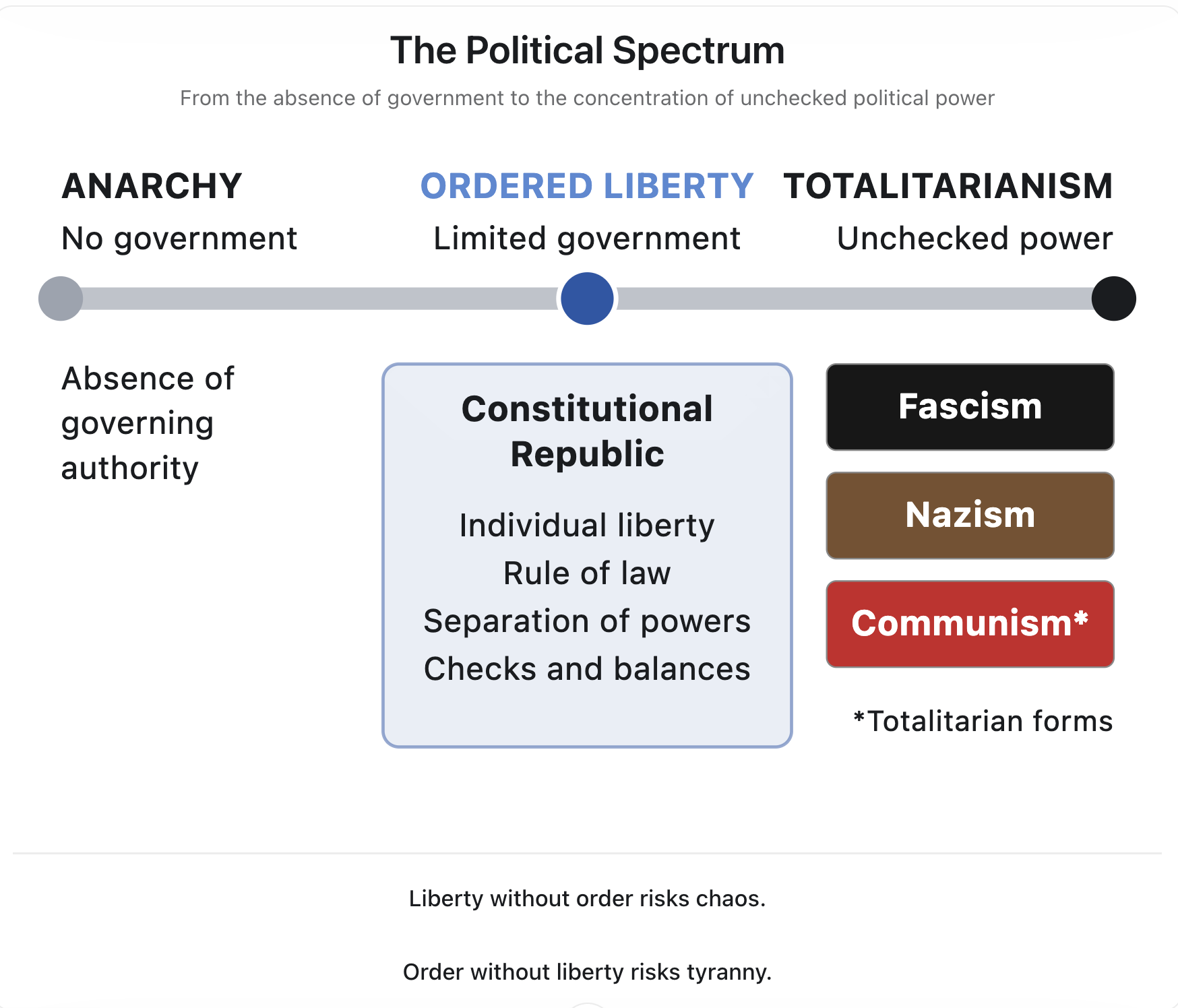
Perhaps this is a good place to explain how I view the political spectrum.
I’ve never found the conventional Left–Right political spectrum particularly helpful. In fact, I think it often obscures more than it illuminates. I prefer to think of the political spectrum in terms of the relationship between political authority and individual liberty.
At one end of the spectrum is Anarchy—the absence of governing authority.
At the other end is Totalitarianism—the concentration of political power to the point that virtually every aspect of human life is subject to the control of the regime.
This is why I place fascism, Nazism, and totalitarian communism at the same end of my political spectrum.
I’m well aware of their ideological differences. Fascists, Nazis, and communists have very different theoretical understandings of the nation, race, class, economics, and the organization of society.
But from the standpoint of political power and individual liberty, their totalitarian manifestations have far more in common than the conventional Left–Right spectrum would suggest.
They concentrate political power. They suppress dissent. They eliminate meaningful political opposition. They subordinate individuals, families, religious institutions, and civil society to the demands of the regime.
Whether my freedoms are being taken away in the name of racial supremacy, national greatness, or the emancipation of the working class makes precious little difference to me.
The ideological justification may be different. The loss of liberty is not.
And I have no more interest in living under the dictatorship of the proletariat than I do in living under the dictatorship of a Führer or an all-powerful fascist state.
The Ordered Liberty of a Constitutional Republic
Between those two extremes—anarchy and totalitarianism—is what I would call the Ordered Liberty of a Constitutional Republic.
And that’s where I locate myself politically.
In that sense, I consider myself a centrist. Not because I occupy some ideological midpoint between today’s Republican and Democratic parties, nor because I believe that political wisdom necessarily resides in compromising between them.
I consider myself a centrist because I reject both the absence of governing authority and the concentration of unchecked political power.
I believe government is necessary to preserve order, administer justice, protect our liberties, and provide the conditions in which individuals, families, communities, and institutions can flourish.
But government itself must be restrained.
That’s precisely why constitutional limitations, the separation of powers, checks and balances, federalism, and the rule of law are so important.
These are not inconvenient obstacles to political progress. They are deliberate safeguards against the abuse of political power. And they should matter just as much to us when the people we support are in power as when the people we oppose are in power.
Why the Rise of the DSA Concerns Me
This brings me back to something I’ve written about extensively in recent months: the growing influence of the Democratic Socialists of America (DSA), whose electoral successes in the November 2026 elections concern me greatly.
Eight DSA-endorsed candidates won election to the U.S. House of Representatives, quadrupling the number of DSA-endorsed representatives in Congress. Dozens of others won elections to state legislatures.
As I’ve emphasized in my previous posts, I would encourage my friends to read the DSA’s own national platform rather than rely upon someone else’s characterization of it.
Among its stated objectives are:
- Abolishing the United States Senate.
- Replacing the presidency and Supreme Court with executive and judicial institutions answerable to Congress.
- Drafting a new constitution and establishing a democratic socialist republic.
- Bringing the largest corporations and essential industries into public ownership.
- Imposing aggressive taxes on accumulated wealth.
- Expanding publicly owned housing and imposing universal rent controls.
These are not simply proposals to improve the functioning of our existing constitutional republic. They represent an explicitly stated ambition to transform both our constitutional system and our economic order.
The DSA describes its objectives in terms of economic democracy, working-class empowerment, equality, and human flourishing. But what concerns me is the concentration of governmental power that I believe would accompany the implementation of these objectives.
In other words, what happens to the constitutional safeguards against the abuse of political power when the executive and judicial branches become subordinate to the legislative branch? And what happens to independent centers of economic power when the government assumes ownership of our largest corporations and essential industries?
I am not indifferent to questions of economic injustice, poverty, corporate corruption, or the abuse of private economic power. Nor do I believe capitalism is exempt from moral scrutiny.
But I reject the assumption that transferring ever more economic power to political institutions necessarily produces a more just society.
Calling something social justice does not relieve us of the responsibility to examine the political means employed to achieve it. Nor does it exempt those entrusted with implementing it from the temptations and abuses that accompany concentrated power.
One of the virtues of democratic capitalism, in my view, is that economic power need not reside in the same institutions that exercise political power. Private enterprise, religious institutions, voluntary associations, and other independent institutions of civil society can serve as important counterweights to governmental authority.
I want to preserve those counterweights, not eliminate them.
And this is why I evaluate political movements not merely by the virtues of their stated intentions, but by the power they seek to acquire, the institutions they seek to control, and the constitutional restraints they are willing to respect.
The Principle Remains the Same
The fundamental political question, as I see it, is not simply whether the Left or the Right should govern. It is how much power those who govern should be permitted to exercise over those whom they govern.
I don’t want an all-powerful government, even one run by people with whom I largely agree. The constitutional restraints I want imposed upon my political opponents are the very same restraints I want imposed upon my political allies.
That is what a principled commitment to constitutional government looks like.
And whether the concentration of political power is justified in the name of national greatness, racial supremacy, economic equality, or social justice, my concern about the concentration of that power remains the same.
Liberty without order risks descending into chaos. Order without liberty risks descending into tyranny.
The genius of the American constitutional experiment lies in its recognition of both dangers and its attempt to establish a political order that guards against them.
That is the political tradition I embrace. It is the standard by which I evaluate political movements, regardless of their ideological labels. And it is the political tradition I believe is worth preserving.
+++